Indictments, Intervention, and the Reassertion of the Monroe Doctrine
With both suddenness and precision, American forces – after a long, steady buildup in the Caribbean in recent months – decisively and with impressive tactical surprise, captured and exfiltrated Venezuelan strongman Nicolas Maduro and his wife in an overnight military operation early on January 3rd, bringing the newly deposed leader to American soil to face justice (for drug trafficking, narcoterrorism, weapons, and conspiracy charges).
- Indictments, Intervention, and the Reassertion of the Monroe Doctrine
- The National Security Strategy and the Arctic Omission
- Greenland Returns to the Center of the Debate
- From Venezuela to Greenland: Reframing the Trump Doctrine
- Louisiana, Landry, and the Limits of Diplomatic De-escalation
- Strategic Deception and the Arctic Blind Spot
- Competing Arctic Interpretations: Doctrine or Distraction?
- From Historical Analogy to Immediate Crisis
- From Provocation to Policy: Signaling Greenland’s Place in the Trump Doctrine
- From Rhetoric to Readiness: Anticipating the Next Move
This operation felt like a remake of 1989’s Operation Just Cause. In that earlier case, American troops with far less celerity invaded Panama to seize its similarly indicted strongman (for racketeering and drug trafficking), Manuel Noriega, who was eventually brought back to America to face justice 42 days after that December 20, 1989 invasion began, after a dramatic standoff at the Vatican Embassy in Panama City.
It is now ever more important that we anticipate Greenland could well be next – and with both prudence and urgency, plan accordingly.
From Operation Just Cause in 1989 to Operation Absolute Resolve in 2026, nearly four decades have passed, yet the pretext for war was one and the same: an American indictment on charges related to drug trafficking, an exiled or imprisoned democratic opposition leader gaining the sympathy and support of a sitting President, and the conflation of national security and law enforcement operations. Together, these elements forged a demonstration of American resolve and power in the western hemisphere ripped straight from the history books, restoring the 1823 Monroe Doctrine to the center of American geostrategy.
The National Security Strategy and the Arctic Omission
If anyone doubted the seriousness of America’s latest National Security Strategy, newly released in late November, those doubts would have been obliterated with the sounds of explosives rocking Caracas. Indeed, just a few weeks ago, when the updated NSS was released, many Arctic experts were left puzzled by the omission of the Arctic from the document, which muscularly re-asserted American predominance of the Americas in a hemispheric re-conceptualization of US security interests.
There was no Arctic section, in contrast to prior NSS documents, and no mention at all of the vast island of Greenland, which has featured prominently in President Trump’s vision of expanded American hemispheric power. Had the President lost interest amidst the strenuous objections of Danish and Greenlandic elites, or was Greenland’s – and more broadly, the Arctic’s – omission from the NSS an illustration of strategic deception, as America continues to plot its next Arctic territorial expansion well more than a century and half after the 1867 Alaska Purchase?
After America’s strike on Venezuela, few observers were thinking about the Louisiana Purchase as a likely model for Greenland’s constitutional future.
More ominously, could the buildup of a potent American naval armada in the Caribbean, once military operations in Venezuela conclude, steam next toward Nuuk for a rapid implementation of phase two of what we can now, without pause, call the “Trump Doctrine,” rather than merely a corollary of Monroe’s infamous doctrine from centuries past? I think it’s possible, despite the fact that it runs quite contrary to the conventional thinking of the Arctic security community, which may not fully grasp the significance and influence of the MAGA movement, or the successful initial implementation of the Trump Doctrine in Venezuela in recent days.
Greenland Returns to the Center of the Debate
Like a North Atlantic iceberg, Greenland had drifted off the global media’s radar in recent months, as other places and events dominated headlines, from the festering military conflicts in Gaza and Ukraine, to the new year’s showdown in Venezuela. But just before Christmas, the drought in headlines ended abruptly, with the media spotlight shining brightly once again on the world’s largest island – bringing an early end to the holiday cheer for many a Dane hoping President Trump’s aspiration for a Sewardian territorial expansion had been superseded by those other pressing issues.

As Royal Danish Defence College associate professor Marc Jacobsen noted on LinkedIn, “Like many, I’ve taken a short break from the holidays to contribute with a few comments on Trump’s decision to appoint a special envoy to Greenland,” adding, ““I don’t believe the US will use military force to take control of Greenland, but we are seeing efforts to gain influence through strategic investments and narratives portraying Denmark as a poor partner. The appointment of Jeff Landry as special envoy and Tom Dans as head of the US Arctic Research Commission should be understood in this context.”
As Jacobsen observes, “In Greenland, these moves appear counterproductive. Rather than building trust, they risk reinforcing the perception of the US as increasingly antagonistic and a less attractive partner on Greenland’s path toward greater independence.” He believes that a “US invasion of Greenland would be catastrophic — effectively marking the end of NATO and any remaining credibility of US commitments to international law. It would also put an end to any peace prize ambitions Donald Trump may hold. That said, I remain confident that such a scenario will not happen, as there are still responsible actors capable of stopping an idea this unreasonable.”
From Venezuela to Greenland: Reframing the Trump Doctrine
But after the swift success of President Trump’s bold military action, where America’s use of force was in defense of both the rule of law and eventual restoration of democracy to Venezuela, while also in support of American commercial interests (particularly regarding oil) and its counterdrug policies, one cannot simply jump to a conclusion that a second assertion of the Trump Doctrine in Greenland must automatically be catastrophic as Jacobsen contends.
President Trump himself described his application of the Monroe Doctrine as the “Donroe Doctrine.”
Given deep moral injustices in past Danish colonial policies in Greenland, and the continued suffering that has resulted (as described here at Arctic Today), one could imagine a confluence of humanitarian intervention, commercial interests (particularly rare earths and uranium), and national security once again aligning as we saw this week in Venezuela, providing justification for another implementation of the Trump Doctrine.
President Trump’s appointment of Louisiana Governor Jeff Landry as his special envoy to Greenland need not be perceived as “counterproductive” as Jacobsen contends, since the appointment of a close confidant of POTUS to advance President Trump’s ambition to extend the geographical reach of the American flag to Greenland could inject new energy and much-needed civility to this long-festering diplomatic dispute between NATO allies. Moreover, for those who fear the bold use of American military force in defense of MAGA values, Governor Landry’s appointment could instead be perceived as reassuring, given that his home state of Louisiana is rich in symbolic and historic significance of a non-military nature.
Louisiana, Landry, and the Limits of Diplomatic De-escalation
As Landry himself has observed, this is because of Louisiana’s heritage as one of America’s largest and peaceful territorial expansions, via the Louisiana Purchase of 1803.
As reported in The Hill, “Look, the United States has always been a welcoming party. We don’t go in there trying to conquer anybody and trying to – you know – take over anybody’s country. We say, ‘Listen, we represent liberty, we represent economic strength, we represent protection … Look, no one knows better than Louisiana. My family has been in Louisiana for over 300 years. We’ve lived under more flags than anyone living in the continental United States over the history of America. We ended up settling under the United States of America’s flag, and for that, Louisiana has been so much better.”
Jacobsen correctly predicted that in response to Governor Landry’s appointment as special envoy, “[f]rom Denmark, Greenland, and Europe, we can expect clear condemnation, continued military exercises, and renewed emphasis on sovereignty and international law. A revised defense agreement may also be proposed – largely symbolic, but offering Trump a visible ‘win’ that could cool things off.” Greenland’s PM declared that he felt “sad” that the American president once more “reduced our country to a question of security and power,” as reported by DW.com.
And The Guardian reported both the “prime ministers of Denmark and Greenland have demanded respect for their borders after Donald Trump appointed a special envoy to the largely self-governing Danish territory, which he has said repeatedly should be under US control. ‘We have said it very clearly before. Now we say it again. National borders and the sovereignty of states are rooted in international law … You cannot annex other countries,’ Mette Frederiksen and Jens-Frederik Nielsen said in a joint statement. The two leaders added that ‘fundamental principles’ were at stake. ‘Greenland belongs to the Greenlanders, and the US should not take over Greenland,’ they said. ‘We expect respect for our common territorial integrity.’”
Strategic Deception and the Arctic Blind Spot
But perhaps critics of Trump’s continued pursuit of Greenland underestimate the raw power of the Trump Doctrine, including Jacobsen’s suggestion that a “revised defense agreement” might cool things down, when what Trump desires is not America’s continued defense of Danish sovereignty over Greenland, but an end to that sovereignty, as envisioned by the Monroe Doctrine. (Indeed, in the hours following his strike on Venezuela, President Trump himself described his application of the Monroe Doctrine as the “Donroe Doctrine,” borrowing this colorful term from a prescient January 8, 2025 front page of the New York Post.)
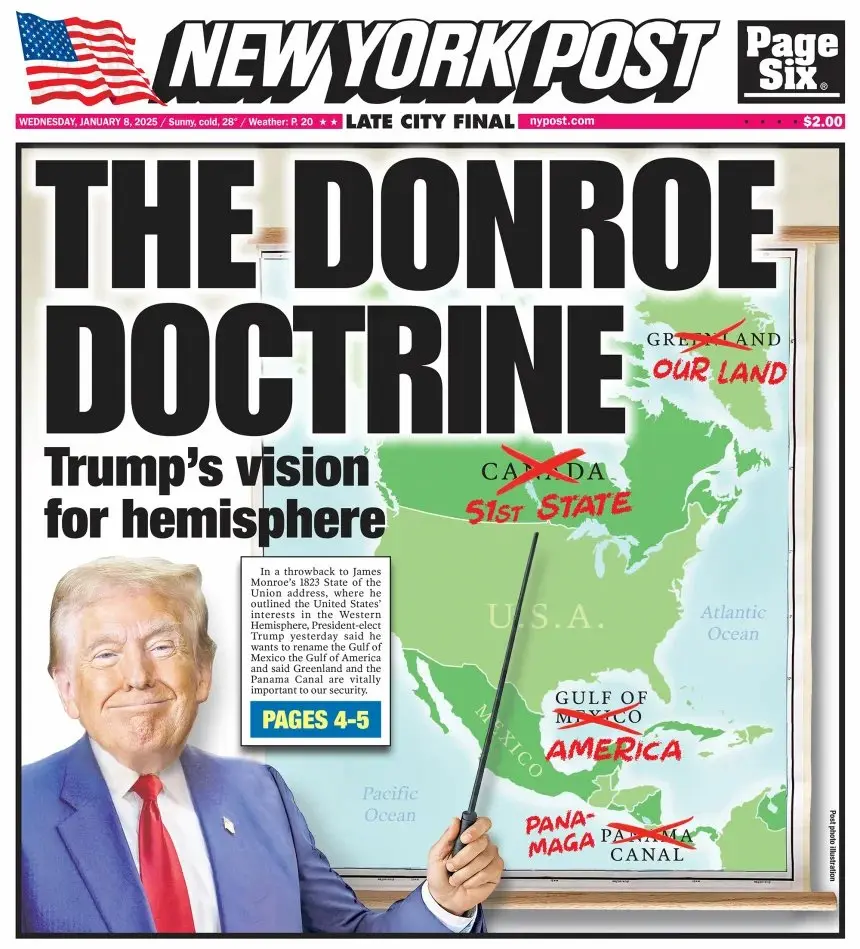
But as the Pentagon built up its potent armada in the Caribbean to pressure the Maduro regime in Venezuela, it left the impression that the White House was seemingly too distracted to focus its attention on icy and remote Greenland. This impression was further reinforced when the White House issued its 2025 National Security Strategy in November, proclaiming an unabashedly America First doctrine of hemispheric security with a decidedly Monroe Doctrine vibe that seemed to ignore the Arctic entirely.
As reported by Malte Humpert in High North News, “The Trump administration’s 2025 National Security Strategy omits a dedicated Arctic section, unlike its 2022 predecessor, but experts say the shift reflects a hemispheric approach—not neglect—with icebreaker acquisitions and the ICE Pact signaling continued U.S. engagement and strategic focus on the North American Arctic. That shift implicitly reframes the North American Arctic – including Alaska, Greenland, and Canada – as part of a broader Western-Hemisphere zone of interest.”
Competing Arctic Interpretations: Doctrine or Distraction?
As an American Arctic security pundit cited by Humpert explains, “It’s not surprising that President Trump’s 2025 National Security Strategy does not address the Arctic directly, given its explicit emphasis on prioritizing ‘core foreign policy interests’,” which suggests the Arctic falls outside the strategic core of North America. The new NSS thus “lays out a ‘Trump Corollary’ to the historic Monroe Doctrine, putting the Western Hemisphere – and, by extension, the North American Arctic – at the top of U.S. strategic concern.”
Humpert also cites an Australian Arctic security pundit who “argues that the absence of a named ‘Arctic’ section does not mean the region has been overlooked” and that the new NSS “is actually a clear signal that the Arctic is an established theater within the Trump administration’s notion of returning to a hemispheric defense strategy.”
In contrast, as geopolitical expert Klaus Dodds observes on LinkedIn, “While it is common for commentators to talk about the Trump Corollary to the Monroe Doctrine, I would focus on another analogy that you will see with current U.S. posture towards Greenland.
Explore Books Written by Our Contributors
Why you might ask was the Governor for Louisiana asked to act as special envoy to Greenland – one answer might be that the potential acquisition of Greenland has been compared by some to the 19th century Louisiana Purchase – in territorial size at least. Before his election in 2024, Trump reportedly told journalists in 2022 that, “I love maps. And I always said: ‘Look at the size of [Greenland]. It’s massive. That should be part of the United States.’”
From Historical Analogy to Immediate Crisis
Governor Landry himself refers to his state’s iconic history and the contemporary relevance of the Louisiana Purchase for America’s pursuit of Greenland, suggesting invasion and annexation are not necessarily his objectives as the President’s special envoy for Greenland.
But after America’s strike on Venezuela, few observers were thinking about the Louisiana Purchase as a likely model for Greenland’s constitutional future. This was because the conversation had shifted at the White House in the exuberant aftermath of the successful Maduro snatch-and-grab, while preliminary confidence in the newly asserted Trump Doctrine was at a zenith.
The headlines have been dramatic, from BBC (“‘We need Greenland’: Trump repeats threat to annex Danish territory”) to The Guardian (“US attack on Greenland would mean end of Nato, says Danish PM: Mette Frederiksen criticizes Donald Trump’s ‘unacceptable pressure’ as Greenland counterpart condemns ‘fantasies’”) and CNBC (“Denmark in ‘crisis mode’ as Trump sets sights on Greenland after Venezuela attack”). As CNBC reported, Trump told the press on Sunday aboard Air Force One, “We need Greenland from the standpoint of national security and Denmark is not going to be able to do it, I can tell you.”
From Provocation to Policy: Signaling Greenland’s Place in the Trump Doctrine
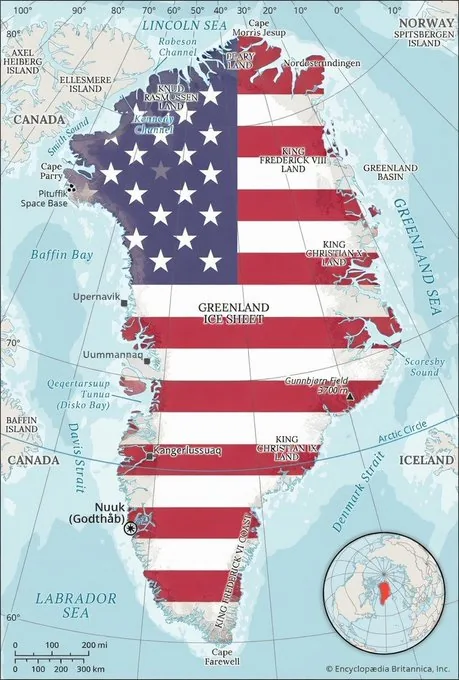
And, if a picture is worth a thousand words, a now iconic image widely circulated from the X account of Katie Miller, wife of Trump’s Deputy Chief of Staff Stephen Miller (a leading architect of Trump’s aggressive Venezuela policy), portrayed a map of Greenland superimposed by the Red, White and Blue with the ominous (to Denmark) caption, “SOON” in all caps – which has since been reposted all around the world, in both mainstream news as well as social media, including the LinkedIn feed of Arctic geopolitics expert Klaus Dodds, cited above, who writes that “the days have long since passed that such images can be simply laughed off. No doubt few in Denmark and Greenland will forget President Trump remarking last year that the US would acquire Greenland one way or another.”
Soon after his wife’s controversial X posting, Deputy Chief of Staff Stephen Miller doubled down on America’s right to possess Greenland in a fiery interview with Jake Tapper on CNN’s The Lead.
Noting Greenland’s small population (and getting it wrong by half, wrongly stating it’s 30,000), Miller added, “The real question is about what right does Denmark assert control over Greenland? What is the basis of their territorial claim? What is their basis of having Greenland as a colony in Denmark? The United States is the power of NATO. For the United States to secure the Arctic region to protect and defend NATO and NATO interests, obviously, Greenland should be part of the United States.” Miller added: “But we live in a world, in the real world … that is governed by strength, that is governed by force, that is governed by power. These are the iron laws of the world.”
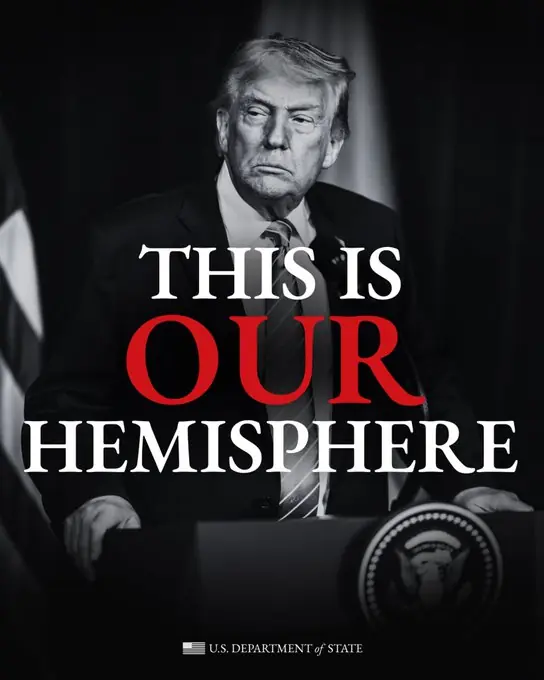
Miller reminded Tapper that the President’s view on Greenland has remained unchanged: “The president has been clear for months now – so I know you’re treating this as breaking news – the president has been clear for months now that the United States should be the nation that has Greenland as part of our overall security apparatus,” and “that’s been the formal position of the U.S. government since the beginning of this administration, frankly going back to the previous Trump administration, that Greenland should be part of the United States.”
From Rhetoric to Readiness: Anticipating the Next Move
When Tapper pressed Miller on the question of force, Miller signaled the unlikelihood that it would come to this: “There’s no need to even think or talk about this in the context that you’re asking of a military operation. Nobody’s gonna fight the United States militarily over the future of Greenland.”
Especially not after the swift and seemingly flawless implementation of Operation Absolute Resolve on January 3rd, following so soon upon the release of America’s new, decidedly hemispheric NSS in November, and followed in turn by such provocative comments from the President and his inner circle.
Together, these suggest that a new, neo-Monroeian era in American foreign policy has begun (a.k.a. the “Donroe Doctrine”) – and that a new, neo-Sewardian era in American Arctic policy could soon follow. As a consequence, it is now ever more important that we anticipate Greenland could well be next – and with both prudence and urgency, plan accordingly.