
Civil Society as Being Promoted and Adopted in China
In the 1980s and 1990s wave of democratization, democracy movements corroborated the role of civil society in democratic transitions. It galvanized civil society promotion from North America and Europe to the global South.
Social movements, rather than NGOs, formed the backbone in the successful campaigns for democratization. However, democracy promoters turned to NGO building as their preferred method of civil society development. Here, they followed the aid industry, which had truncated civil society into registered NGOs with bank accounts to facilitate development aid distribution through non-state actors.
Using globalization theory, my book sees liberal civil society ideals as something actively exported to China by foreign democracy promotion programs, international aid organizations, and scholars. The book makes visible that not only the Chinese state but also foreign donors wanted to mold Chinese society and emerging NGOs according to their expectations.
The book shows that liberal democracy does not travel as a package, but the locals always select and translate liberal ideas to their own situations, needs, and institutional settings.
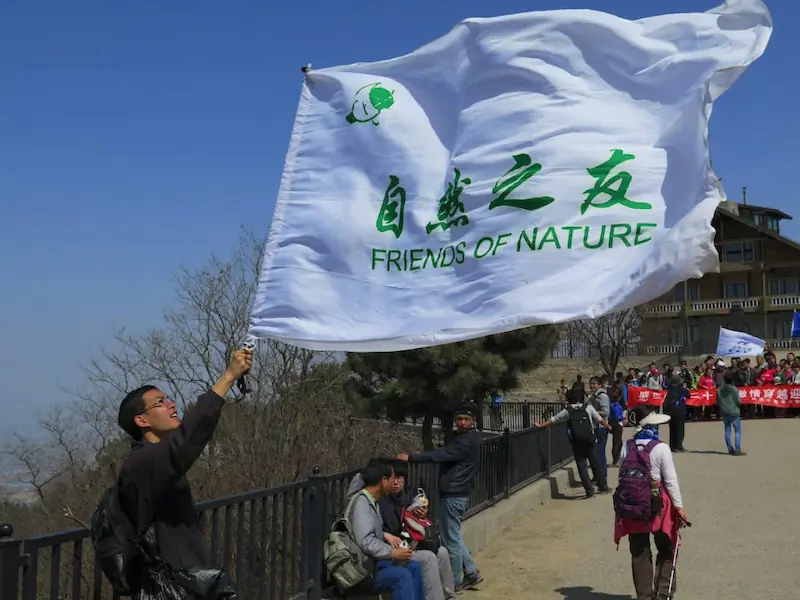
Simultaneously, many Chinese willingly adopted the NGO form because it appeared as a step towards global modernity. They were drawn to novel ways of doing things professionally with NGOs. My book celebrates the Chinese who made NGOs their own and used them as vehicles to open Chinese political processes to social initiatives.
Early NGOs operated in a society where most people and government officials knew nothing about them. Even government-organized NGOs needed to prove that they could do grassroots aid programs that used to be government-run, while a small environmental group could be warmly received by a local government that had expected an official delegation instead.
I organize the book introduction around the main liberal takeaways of my book. The book is organized somewhat differently around the themes relevant to globalization and localization. One chapter, for example, explores Chinese efforts to adjust NGOs to the specific Chinese setting with values and political institutions of its own. Another introduces social spaces where civil society promotion did not reach.
Frictions Between the Global and the Local
Globalization involves what Anna Tsing calls frictions between global universals and their local applications. Friction was noticeable between early Chinese NGO practice and foreign donors’ fixed ideas about what being a professional NGO entails.
Early NGOs struggled to become organizations. They had started as informal gatherings of like-minded people. Many valued networked voluntarism over organizational hierarchies as more democratic. Still, foreign donors pressed for clear organizational structures. Donors expected official registration when Chinese laws allowing it were not yet in place. As a result, the ones that could register were negatively labeled as government-organized NGOs.
Chinese NGOs were aware of unrealistic demands from donors. Most dismissed the strict state-society boundary demanded of them. They felt adequately social if they determined their own programs. Culturally primed to value social networks, they felt it unwise to antagonize officials with whom they might need to cooperate in the future.
Chinese NGO advocacy resembles lobbying more than collective demand-making by social movements. It promotes ideas through interpersonal networks with state officials who share common goals or through public discussions into which NGOs want to include administrators. In China’s decentralized system, even an individual district-level administrator can decide to support HIV education in schools or open doors to waste management planning.
Many NGOs complained about how useless donor-provided capacity building sometimes was. Donors introduced foreign advocacy strategies as if the Chinese NGOs could use them despite fundamentally different legal systems and laws. NGOs became disillusioned when the project funding ended just when they had learned to design even better projects.
NGOs themselves complained that early Chinese NGOs relied too much on the Euro-American models instead of developing their own. They like projects that spread awareness through personal encounters, show practical results, and offer models for others to learn from. All of these approaches are familiar from Confucianism.
Some NGOs’ overreliance on foreign models became evident in 2016 when China started to regulate foreign NGOs in and donations to China. When foreign funding dried up, NGOs without a domestic base faded out.
Democracy and Public Voice
Several chapters examine the difficulty of identifying Chinese political influencing by using liberal paradigms, which deem Chinese NGOs as nonpolitical despite their success in blocking public projects and adding their demands into laws. Instead of seeing politics as a public pursuit of individual preferences and interests, Chinese NGOs understand it as a strategic game offering multiple meaningful ways to pursue the same goal.
Chinese NGOs value democracy. They are adamant that society needs to be heard in decision-making. Still, Chinese NGOs do not seek to represent people. Instead, they involve the public in discussions and information gathering on social and environmental issues. They introduce channels for people to voice their experiences, report problems, or send policy feedback individually.
Although democracy is widely accepted by Chinese NGOs, many other liberal ideas, such as interests and rights, did not stick.
NGOs value community-level action as an arena in which everyone can participate and voice their opinions. It may appear nonpolitical but is actually a democratic strategy to build social awareness and citizenship skills.
For Chinese NGOs, democracy means popular participation even if it takes place in people’s everyday lives and communities.
Everyday action can be influential in Chinese culture, where practice is more valued than voiced demands. NGOs lobby by introducing novel models of environmental governance or social service provision. They leave it to the state to scale up successful projects.
Everyday knowledge gives a political edge. In policymaking, NGOs gain credibility for their demands by putting on the table information from communities and ecosystems that no other party has. They know exactly where endangered species live or what the needs of a vulnerable social group are. Staying close to everyday people is a moral choice, but it is also a politically expedient choice.
Euro-American philosophy understands politics as public speech and prioritizes public life over the social and private spheres. In contrast, Confucianism does not raise speech over practice. It does not separate the public from the private. Instead, it sees that individual and social action can change political realities. In this line, Chinese NGOs advocate not only by making public demands but also through personal networks, practical action, and social programs to make society better.
Rights and Repression
Although democracy is widely accepted by Chinese NGOs, many other liberal ideas, such as interests and rights, did not stick. Chinese NGOs rather use public interest language and talk about responsibility to take the vulnerable groups into account.

‘Human rights’ is a term almost unused in Chinese NGO advocacy, although it is not a forbidden term. The only human rights NGO in China is an official one. In domestic arenas, it appeals to human rights to improve collective social rights.
During Hu Jintao’s presidency (2003-2013), the government still promoted rights defense as a way to remove social conflicts from governments to courts. That came to an end with President Xi Jinping (since 2013). His government quickly repressed the liberal-minded activists whom I call in the book as the Principled.
However, the repressed were a minority. No single NGO experience exists in China, but it depends on the topic, advocacy method, location, and relevant governmental agency. The state invests in cooperation and even facilitation where it sees NGOs as useful.
Repression is a very targeted instrument in the larger palette of Chinese social management methods. Most NGOs do not experience repression. In this context, the repressed receive little sympathy from other NGOs that blame the repressed for asking for trouble.
When approaching sensitive areas, NGOs receive warnings or indirect hints from the authorities. If that happens, the NGO still has much leeway to adjust its activities. If one campaign proves too sensitive, they can start a campaign against another target.
Even if the NGO is closed by the authorities, it can fall back into semi-private networks or even register anew. It even happens that, after the closure of a controversial NGO, its local chapters continue to function because local governments recognize the need for its services.
Lobbying and Lawmaking
Most Chinese advocacy NGOs always accepted that, without any realistic alternative to the Communist Party rule, they need to navigate the existing political system to reach their goals. Instead of rights-based claims, they make public-interest claims to improve the environment, women’s status, and marginal social groups’ well-being.
“We do what we can,” they often say.
They have found that they can do quite much in the Chinese system that builds regime legitimacy on performance; assigns clear functional mandates to state agencies; seeks feedback from society about its policy performance; values policy research and small-scale experimentation in the policymaking process; and welcomes policy entrepreneurship from individual bureaucrats and outside experts alike.
Now a separate location of civil society exists with its own voice in policymaking.
Although Xi Jinping’s regime is suspicious of rights protection, it has promoted the rule-by-law. This has provided Chinese NGOs more opportunities to participate in the lawmaking process. Advocacy NGOs not only promoted legislation useful for their causes, such as legislation passed to tackle sexual harassment or bringing the discussion on same-sex marriage in the legislature for the first time. NGO lobbying also inserted into laws new methods for NGO advocacy, such as public interest litigation and the real-time transparency of pollution data.
After all, law is not just about rights. As Michel Foucault reminds us, law is a tool of governmentality. Legislative advocacy by Chinese NGOs has made, for example, domestic violence or industrial pollution from private or ungoverned issues into governmental issues. Here, NGOs want to direct what the government does instead of minimizing the governmental reach.
Social Outsides of Civil Society
As liberal civil society was a foreign idea to the Chinese, it did not take off at once throughout society. Many Chinese continue to organize like they always had in customary social spaces called minjian (among the people). Minjian is where dissidents used to convene. Even now, Chinese protests are organized through informal minjian networks without NGO presence.
Like liberal civil society, the customary Chinese social space of minjian emphasizes voluntary collective self-organizing outside the state, but it does not contain other liberal expectations of publicness, voice, or rights. Minjian takes any form and cause participants want it to, while civil society is limited to a specific social location and repertoire.
The book shows how elderly gays in minjian spaces and the global Pride movement alike succeeded in building gay communities and acquiring visibility in Shanghai. It visits informal democracy corners and underground art circles that organize in minjian spaces. Although the organization model is local, they are not outside other global flows.
NGOs’ urban middle-class position can lead to interest conflicts with others in society. When environmentalists want to transform agricultural land into nature reserves, their work culture involving meetings, planning, and reporting brings them closer to the government than to the farmers.
How Did China Change With NGOs?
From the perspective of globalization and localization, the book concludes that the glocalization of NGOs into the Chinese political system was a success. In the 20 years I have followed Chinese NGOs, advocacy NGOs claimed a recognized voice in policy, if not also in politics.
In China, NGOs adapted to the domestic institutional setting and social values. The Chinese state actively contributed to localization, although this sometimes meant cutting off some, often more liberal, sprouts. Nevertheless, NGOs managed to create something new in this constrained environment.
Explore Books Written by Our Contributors
From the liberal perspective, the result is mixed. Single-issue advocacy NGOs developed into lobbying machines rather than into democracy movements challenging the government. The early civil society promoters’ expectation that civil society leads to liberal democracy not only failed, but in recent years, authoritarianism has even hardened in China.
Perhaps this could have been anticipated. Civil society building focused on engineering society, not the state. Chinese society is now a fundamentally different space than it was three decades ago. Now a separate location of civil society exists with its own voice in policymaking. What once was consultation of NGOs as individual experts has grown to participation in governance.
The book shows that liberal democracy does not travel as a package, but the locals always select and translate liberal ideas to their own situations, needs, and institutional settings. However, the book confirms the appeal and relevance of liberal civil society ideals even for people living under a non-liberal political system.