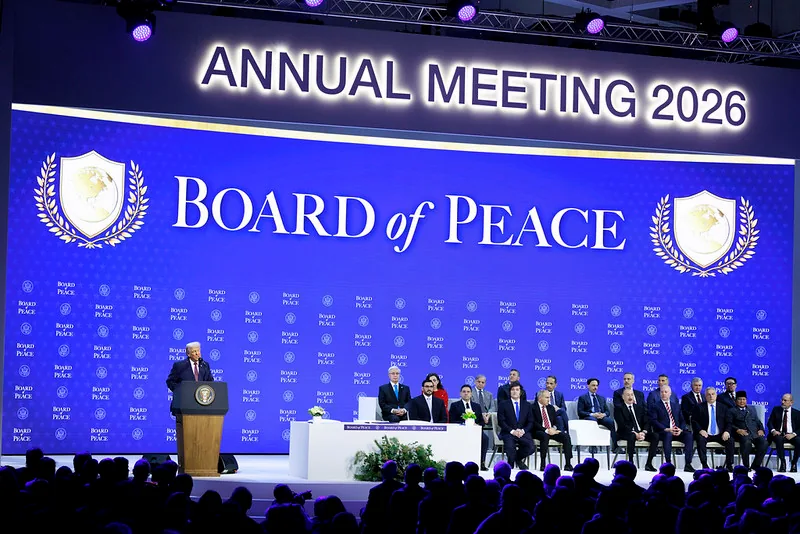
In November 2025, the UN Security Council endorsed a “Board of Peace” as the transitional authority for Gaza. Its charter names Donald Trump as chairman, with power over its agenda and the final word on how the charter is read. Permanent seats came with a price tag of a billion dollars, and plans presented at its first meeting included a “Gaza Riviera” of high-end towers along the coast. No Palestinian sits on the Board.
Critics point to its pay-to-play membership, its closeness to commercial interests and the absence of the people it claims to govern. These charges make the Board easy to dismiss as a symptom of corrupt elite politics, even as it is grudgingly accepted as the body that will manage Gaza’s reconstruction. That ease of dismissal leaves a deeper idea undisturbed.
The international justice agenda tells its story as a series of wins: just wars won against evil powers, court cases won against perpetrators, elections won on rational policies.
In this idea, sometimes described as a lay theory of “negative peace”, peace is a product of control. It rests on “peace through strength”, or at least on a commitment to punish the perceived aggressor, and it arrives when the war is declared over, and the stronger side sets the terms the weaker must accept. People who lived through the violence appear as recipients of the arrangement, expected to be grateful for a security delivered through separation, policing and control.
The Victor’s Peace
The Board states this idea with unusual frankness, but it is no outlier. Israel has repeatedly named “total victory” as the only acceptable outcome of its war in Gaza.
In the war with Iran, Trump declared on 6 March 2026 that there would be “no deal with Iran except UNCONDITIONAL SURRENDER!”, and Washington was later frustrated by its inability to dictate the terms of its end.
In Ukraine, analysts argue that the Kremlin has intensified strikes on civilian infrastructure to compel Ukraine to capitulate by the spring of 2027. Putin has denied seeking an unconditional surrender, but recurring escalations and the rejection of negotiations suggest otherwise.
Critics of such demands usually call them unrealistic, citing technological changes, logistical challenges and civilian resolve. That objection concerns feasibility, and it leaves untouched the question of what kind of world total victory creates, and what it makes of those who pursue it. It also assumes that violence is the obvious route to security, although in most other areas of life we accept that compromise, repair and introspection resolve conflict better than domination and control.
Learning from Those Who Build Peace
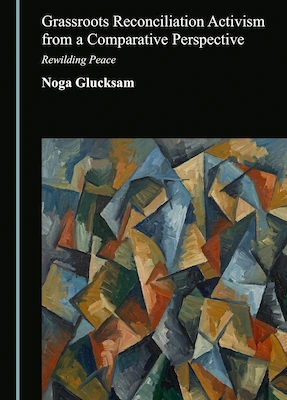
In my new book, Grassroots Reconciliation Activism from a Comparative Perspective: Rewilding Peace, I follow people and organisations who have tried to build peace in eight countries, from Colombia to Northern Ireland and from Uganda to Israel/Palestine. Their experience suggests that victory and control work against reconciliation, and that peace requires an everyday sense of togetherness that reaches beyond politics, identity and justice to a simple shared life.
Grassroots activism is often celebrated as part of a healthy democracy, alongside the state and often subordinated to it. Peacebuilding and human rights literature hails activists as “partners” of international institutions, but only so far as they align with institutional goals and norms. This extends the notion of peace as the victory of right over wrong, in a softer light. Understanding grassroots activism therefore requires examining our attachment to righteous victory, and learning to resist it.
The Appeal of Victory
The idea of victory has an obvious appeal. It promises an ending, a clear verdict on who was right, and a sense of returning to pre-war “normal” life. Its logic, however, runs counter to everything peace requires. Winning is about having your way and proving the other side wrong, without compromise, complexity or empathy.
Grassroots processes that engage the contradictions of victimhood will sometimes fail.
At best, the losers must concede. At worst, they are humiliated, made to pay reparations or subjected to further violence, which they are said to have brought upon themselves. Victory can produce quiet, and quiet can look like stability. It also entrenches the power relations that produced the violence, and risks hardening grievances.
Peace requires spaces in which former enemies can live together without violence or domination. That, in turn, depends on recognising the humanity of the other side, as well as its agency and political aspirations.
People who are denied a say in the terms of their own future do not disappear. They wait, resist or organise, and settlements that ignore them become brittle. Settlements framed as endings tend to fail for this reason.
Frozen Settlements
The 1995 Dayton agreement ended the fighting in Bosnia and Herzegovina, but it froze the conflict by making ethnic division the permanent basis of politics. The power-sharing system it created can only work through cooperation between ethnic elites, but it rewards each of them for mobilising their own community against the others.
No one stands outside the ecosystem to judge it from above.
Within this structure, each community made its willingness to reconcile conditional on first being recognised as the victim, and reconciliation became a competition over whose suffering would count.
A settlement that made ethnic division the organising principle of political life left reconciliation no room to grow outside the categories the war had produced.
Radical Empathy Is Threatening to Those Who Fear Conflict Resolution
Recognising the other side’s humanity is often dismissed as sentimental, or as something that can wait until the fighting stops. The people I learned from treat it as the beginning of politics. Every year since 2006, the Parents Circle Families Forum, now together with Combatants for Peace, has held a Joint Israeli-Palestinian Memorial Day ceremony on the eve of Israel’s official day of mourning.
Memorial Day is one of the rituals through which the Israeli state builds its legitimacy, placing Jewish loss at the centre of national identity and leaving Palestinian loss out of view. The joint ceremony takes the same evening and fills it with both, in Hebrew and Arabic.
At the twentieth ceremony in April 2025, Sayel Jabareen of Combatants for Peace spoke of the capacity “to recognise the pain of others without turning away from our own suffering”. A year later, Liora Eilon of Kibbutz Kfar Aza, whose son Tal was killed on 7 October 2023, opened the speeches. Kholoud Hushiya from Jenin, whose son was killed by the Israeli army in 2023, addressed the same gathering by video.
The ceremony does not ask anyone to agree on the history of the conflict or on its solution. It insists that the other side’s grief is real, and that its people are subjects with their own claims and not objects to be arranged.
Opposition to the ceremony has hardened as it has grown. Israeli authorities have repeatedly refused entry to Palestinian participants from the West Bank and Gaza. On the evening of the twentieth ceremony, dozens of right-wing activists stormed a Reform synagogue in Ra’anana that was screening it. They threw stones and fireworks and chased attendees with chants of “May your village burn” and “Go to Gaza”.
A politics built on victory depends on the claim that only one side’s dead may be grieved. A gathering of bereaved families who mourn each other’s dead threatens that claim at its root, and the people who attacked it understood the threat more clearly than many of its sympathetic observers.
Recognition Without Guarantees
Here the argument becomes uncomfortable. Recognising the humanity of the other side guarantees no good outcome. In long conflicts, victims and perpetrators often belong to the same communities and even the same families, and victimhood carries a moral standing that can be claimed in place of responsibility, so recognition can be abused.
Controlling the process offers no protection from this. Liberia’s truth commission, shaped with the involvement of the armed factions, fixed people into categories of victim and perpetrator, and the victim category soon became a refuge for perpetrators seeking absolution. Control did not prevent the abuse, and it gave the abuse an institutional form.
The possibility of abuse is therefore no argument for controlling outcomes. Grassroots processes that engage the contradictions of victimhood will sometimes fail. Those involved, however, live with the consequences, and this gives them the capacity to notice failure and correct it from within.
Recognition also asks something of those who have suffered most, at the moment when they have the strongest reasons to refuse. The alternative, however, is a peace defined entirely by the side that can impose its terms, and history offers few examples of such arrangements lasting without continuing coercion.
Peace as a Living System
If peace cannot be won, then perhaps it needs to be reimagined. Modern states have often treated society as a garden to be managed and controlled, not a delicate ecosystem where all parts are connected. In Zygmunt Bauman’s account, the gardener begins with a design of the ideal order, and that design decides which growth deserves cultivation and which is a weed.

Weeds are condemned for having no place in the plan, so their removal can be presented as care for the garden. The same ambition that produces order therefore also produces people who are surplus to it, and modernity has repeatedly treated such lives as waste to be cleared.
Peace plans drawn up in capital cities work in much the same way. They choose which actors are legitimate, which identities count and which outcome the landscape should produce. Those who do not fit the design become the settlement’s waste, and their exclusion is presented as the price of order.
Rewilding, the ecological concept at the heart of my book, offers an alternative perspective. Ecologists who rewild a landscape remove barriers, reduce human control and let the system find its own balance. A healthy ecosystem has many species, many pathways for energy and nutrients and enough redundancy to absorb shocks. A monoculture can look orderly and productive, but it is fragile, depends on constant intervention and fails badly when conditions change.
Wildness and Intervention
Rewilding does not mean walking away from the world’s conflicts and letting the strongest prevail. The idea of wildness (as opposed to wilderness defined as the “other” to human civilisation) centres on a system’s capacity to organise itself. Applied to peace, wildness describes communities shaping their own relationships while others remain present and engaged.
The question for outside actors therefore concerns the kind of intervention they make. Some interventions remove barriers, protect those most exposed to harm and open space for people to organise their own lives. Others direct outcomes, and beyond a certain threshold they erode a society’s capacity to regulate itself, so that order holds only while the manager remains.
A society released from external design will produce arrangements that match no one’s blueprint, including one’s own, and this unpredictability is the sign that its processes belong to it. Accepting this means giving up the authority to decide from outside what a peaceful society must look like.
Implications for Justice and Peace Seekers
The victor’s peace and the liberal peace keep the same calendar. Both treat peace as an ending, after which “normal politics” resumes, the terms of the settlement count as final and whatever remains unresolved is deferred to an institutional future. Communities emerging from war are told to wait for security and healing, and the cost of waiting falls on those with least power.
Grassroots reconciliation keeps a different time. The bereaved families who mourn together on the eve of Memorial Day did not wait for a settlement to permit their mourning. Nor did the Bosnians who protested together in 2014 under the slogan “we are hungry in all three languages”. Both involved relationships in the present. A balanced ecosystem works in the same way; its balance is continually being found and never reached once and for all.
Those of us who seek justice are not exempt from this critique. The international justice agenda tells its story as a series of wins: just wars won against evil powers, court cases won against perpetrators, elections won on rational policies. Many of these wins were hard-fought. Still, when justice is conflated with winning, legal and quasi-legal settlements crowd out other ways of repairing harm, and justice becomes something one side does to the other.
No one stands outside the ecosystem to judge it from above. In this sense, I would argue, all politics is peacebuilding politics, including the politics of waging war, and the justice seeker takes part in it with stakes and blind spots of their own. Rewilding therefore asks those of us who stand for rights to give up the comfort of being on the right side of history, without pretending that every claim is equal.
It asks us to value a society’s capacity to argue, mourn and correct itself above the satisfaction of a final judgement, even when things go badly and the pressure to intervene grows. A peaceful world imagined as an ecosystem would have no Board of Peace to govern it. It would hold many forms of reconciliation side by side, each answerable to the people who live with its consequences.