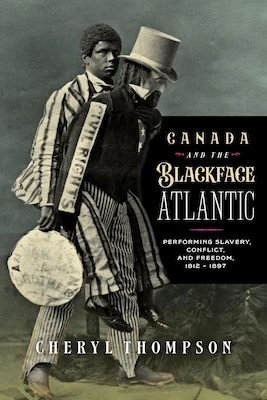
This book took me 15 years to write. Since 2011, I have collected over 3,000 records (and counting). Between 2022 and 2024, while writing Canada and the Blackface Atlantic: Performing Slavery, Conflict, and Freedom, 1812-1897, I realized that I could not contain the story within one book; Staging Blackface in Canada: Public Amusements, Variety Shows, and Racial Acts in an Age of Imitation, 1898–1919 (2026) became the second book in what will ultimately become a 3-book volume.
- Late-Nineteenth-Century Public Exhibitionary Culture
- Black Musicals and European Imperialism Collide
- Canadian Lynching News as a Form of Anti-Blackness
- Black Americans’ Quest for Civil Rights as the Last Musicals Tour Canada
- Why These Performers and Musicals Were Forgotten
- Black Lives Cut Short
- Conclusion: This Work Was Challenging
By tracing which performers and variety shows came to Canada from the US, where they performed, how audiences received them, and what aspects of blackface appeared on stages at the end of the nineteenth century through the early twentieth centuries, Staging Blackface in Canada parses out how the demographics of Canada began to change, and how the dominant cultural group—white Anglo-Protestants—responded.
Late-Nineteenth-Century Public Exhibitionary Culture
When variety theatre arrived, it borrowed elements from the legitimate theatre (its operas, operettas, and wholly danced performances), but it also took aspects from the minstrel show like the burnt-cork mask (blackface), and songs and dances from minstrelsy, while innovating the stage to include comedic routines plucked from the immigrant experience in the Western world.
Further, the “exotic” dances of non-white women at world fairs, amusement parks, and public exhibitions led to an “exhibitionary culture” which represented a broad set of practices, ideas, and attitudes around display and exhibition of people, products, and images in public spaces.
As touring companies moved step by step across the continent, trying to end one engagement within a day or two’s travel of the next, and reliable transportation made tours even longer, by the end of the nineteenth century, the possibilities for staged performance expanded beyond what had been thought of as legitimate drama.
This new form of theatre, called vaudeville, featured stage singers, cakewalking, buck-and-wing, soft-shoe (and eventually tap) dancers, jugglers, magicians, ventriloquists, comedians, acrobats, dog-and-pony acts, minstrel show acts, and hypnotists all rolled into one extravaganza.
Vaudeville did not simply elevate the minstrel show by focusing less on political conflict, the slave-freeman binary, and the location of the Southern plantation versus the urban Northern industrialized milieu; rather, it introduced elements from the exhibitionary culture, which validated imitating the Other as something new in terms of theatrical entertainment.
Just as railways had created intraregional travel and intercontinental connection in the mid-nineteenth century, by the century’s end, electrified amusement parks connected the public with outdoor amusements, exposing people of all social classes and genders to the new spaces of leisure, and to the new possibilities for fun in the modern era.
Black Musicals and European Imperialism Collide
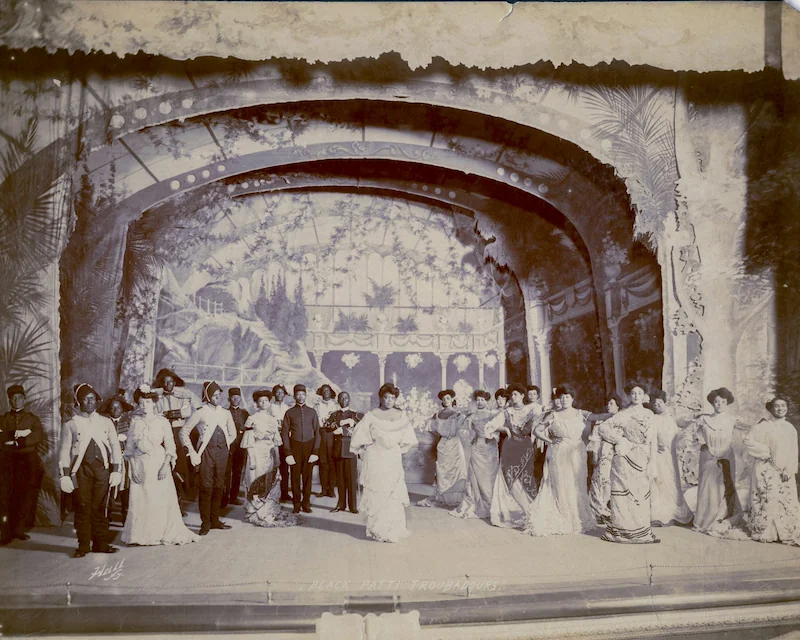
Between 1896 and 1903 there were six Black musicals that toured Ontario, Montreal, Winnipeg, and Vancouver. The first group of musicals created the genre by introducing audiences to a blending of exhibitionary themes and minstrel repertoire:
- Octoroons (1895–96);
- Oriental America (1896; 1898);
- Black Patti Troubadours (1897–1906);
- A Trip to Coontown (1897–1900).
While there were other all-Black shows during the 1890s like Will Marion Cook’s (1869–1944) and Paul Laurence Dunbar’s (1872–1906) Clorindy: Or the Origin of the Cakewalk (1898), the musical did not tour Canada. The second wave of Black musicals arrived between 1899 and 1903, and they featured:
- The Coontown 400 (1900);
- In Dahomey (1903–5).
The second wave of Black musicals drew less on “exotic” tropes and instead emphasized sub-Saharan Africa. Black performers looked to African settings to showcase their multi-faceted artistic talents and escape minstrel caricature, but also to reimagine Black expression and storytelling in an era when the continent was becoming the site of conquest for Western nations.
Most prominently, the so-called “Scramble for Africa” covered a nearly fifteen-year period beginning at the Berlin Conference held over 1884 and 1885 when Britain, France, Portugal, Germany, and Belgium, among others partitioned the continent of Africa into spheres of influence, protectorates, colonies, and then waged wars such as the Boer Wars of the 1880s and 1890s for control of southern Africa. The term “White Man’s War” is believed to have originated during this period.
Canadian Lynching News as a Form of Anti-Blackness
There has been little scholarly attention paid to the history of Canadian newspaper coverage on American lynchings despite a substantive archival newspaper record. The literate Canadian class—primarily white Anglo- Protestant men—were kept abreast of lynchings through reports that appeared as thirty- to fifty-word notices, and sometimes as front-page, full-page-length columns over the 1900s.
Theatrical critics could see the American annexation of the country’s theatres, but they could never see how these theatres had exercised near monopoly control over Black people’s right to exist on the stage.
Even though these reports were presented as “news,” they often included details that did more to sensationalize the violence than critique it, such as detailed accounts of not just a lynching but mutilation, shooting, and torture of Black men, and sometimes Black women and children. Reports often also emphasized the size of the white mobs committing the public crucifixion.
For example, in a report of a Black man lynched in Richmond, Virginia in 1900, in addition to a headline that read, “Negro Murderer and His White Companion are Victims of Judge Lynch,” the Toronto Daily Star’s report noted that “A reign of excitement in Grenville County culminated to-day in a double lynching at Emporia … a mob variously estimated at from 1,500 to 2,000 strong.”
Canadian lynching news spoke to the ways in which Black men were not only framed as rapists, but also (paradoxically) as victims. This duality was not singularly an American construction but was a mythology also created in Canada, reaching the very public that would have had little to no personal interaction with Black people.
Black performers largely left out of vaudeville a generation before were able to become stars of the stage while living in a sociopolitical climate where lynchings, the threat of lynchings, or news reports on lynchings were ubiquitous.
Black Americans’ Quest for Civil Rights as the Last Musicals Tour Canada
On February 5, 1906, Booker T. Washington (1856–1915), the first president of the Tuskegee Normal and Industrial Institute (now Tuskegee University) in Alabama, and one of the best-known Black political figures in the Western world at the time, appeared in Toronto to deliver a speech on Black civil rights as part of a tour that included stops in Ottawa and Montreal.
The story of the American South was known to Toronto’s Anglo-Protestant elites because jubilee singers from the Fisk Jubilee Singers (who started out on a small fundraising tour for Fisk University in Nashville, Tennessee in 1871) to the Hampton Jubilee Singers (of Hampton University founded in Virginia in 1868) were perennial favourites in the city.
Also in 1905, a group of over thirty Black American intellectuals, including Pan-Africanist intellectual W.E.B. Du Bois (1868–1963) and newspaper editor and real estate businessperson William Monroe (1872–1934), held a secret meeting at Fort Erie, located on the Niagara River, directly across the Canada-US border from Buffalo, New York.
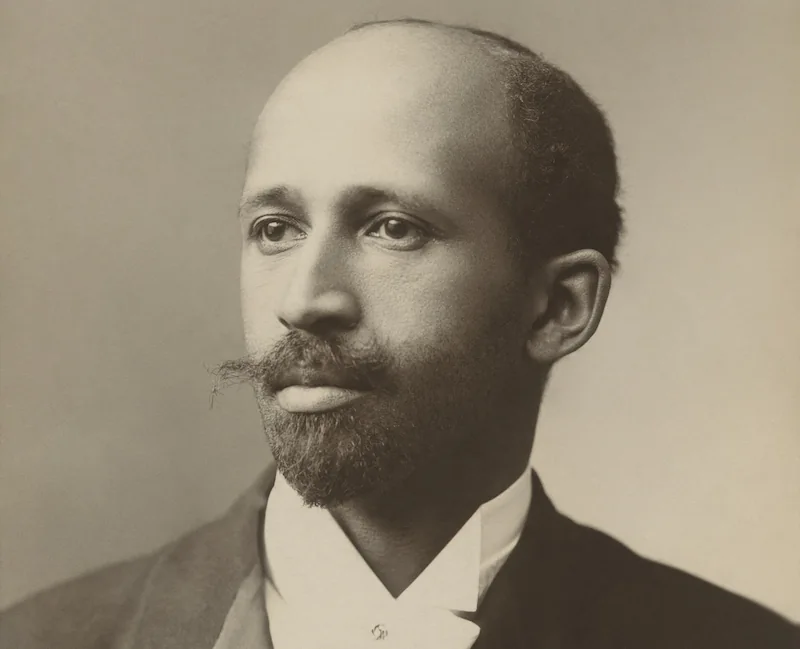
Known as the Niagara Movement, the meeting aimed to strategize on how to combat racial segregation and lynching, which included a campaign to demand full suffrage rights for Black men, equality in public accommodation, freedom of association rights, and equal enforcement of the law.
During this period, the last Black musicals that toured Toronto and Montreal included:
- Abyssinia and Bandanna Land, which headed to both cities in 1907 and 1908, continued to lean on minstrel and “exotic” themes;
- The Shoo-Fly Regiment (1907) became the first Black musical to raise questions about American imperialism in Asia, specifically it was a commentary on the American annexation of Spanish-controlled Cuba and the Philippines;
- The final Black musical, The Red Moon (1910), granted Black composers, playwrights, actors, and singers an outlet to comment on American colonization at home by addressing Indigenous themes. Set in the fictional town of Swamptown, Virginia, on an Indigenous reservation somewhere in the Rocky Mountains, The Red Moon was based on the real-life Black and Native American educational program at Hampton.
Why These Performers and Musicals Were Forgotten
In his 1930 novel, Black Manhattan, James Weldon Johnson (1871–1938), writer of the lyrics for the unofficial Black American national anthem “Lift Every Voice and Sing” (1900), described the disappearance of Black performers from the New York stage that took place between 1910 and 1917 as a “virtual exile.”
With the emergence of sound recording, racial caricature became embedded into the everyday culture by the 1920s.
By the time musician-songwriters Noble Sissle (1889–1975) and Eubie Blake (1887–1963) produced one of the most popular Black musicals of the 1920s, Shuffle Along (1921), with book by the comedy duo of Flournoy Eakin Miller (1885–1971) and Aubrey Lee Lyles (1884–1932), there was little memory of the previous twenty years because many of the performers had unexpectedly died.
Black Lives Cut Short
In 1909, Ernest Hogan (1865–1909) died of tuberculosis. In an obituary in the Montreal Star, the paper noted that “For several years [Hogan] was with Black Patti and her ‘Troubadours,’ and later went to Australia, where he remained for two years with one of his own shows….” The paper also added that he was billed always as “The Unbleached American” because unlike most of his contemporaries, he did not perform in blackface.
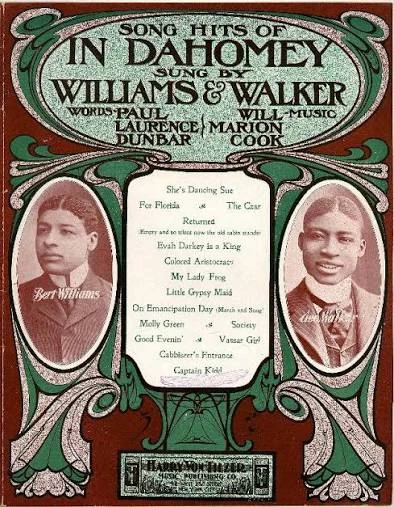
In 1908, both George Walker (c. 1872–1911) and Bob Cole (1868–1911) contracted syphilis. While Cole recovered, after leaving the Bandanna Land tour in 1909, two years later, Walker succumbed to the sexually transmitted disease. His passing was of such significance to Western Canada that the Winnipeg Daily Tribune posted a notice about the “Negro comedian” who died, describing him as “long associated with Bert Williams.”
During this time, J. Rosamond Johnson (1873–1954), who had played a role in most of the Black musicals of the 1900s, embarked on a solo vaudeville career in London, while his brother, Weldon Johnson, left vaudeville to become the secretary of the National Association for the Advancement of Colored People (NAACP).
After The Red Moon closed, Cole attempted to return to vaudeville, but he subsequently retired. In 1910, he entered a sanitarium with depression and a year after that he died by suicide. The final blow to this triumphant era took place when In Dahomey and The Red Moon star Aida Overton Walker (1880–1914) also died suddenly from kidney failure.
Just one year after Shuffle Along’s debut, Bahamian-born Bert Williams (1874–1922), who was forty-six years old, collapsed while on stage in Detroit during a performance of the song “Under the Bamboo Tree,” written by Cole and Rosamond Johnson in 1902, and died. Williams had been one of the only Black actors to appear on touring stages in the 1910s.
Conclusion: This Work Was Challenging
It took a herculean effort to write this book. In addition to understanding the American story of vaudeville and its perpetuation of blackface caricature, I also had to contend with Canadian interpretations of American blackface and the ways in which theatre critics (and by extension audiences) distanced themselves from conversations regarding race and the imposition on the Black actor to assume the racial mask of minstrelsy.
I also had to contend with the absence of critical discourse about anti-Blackness in Canada during this period, and the presence of newspapers’ serialization of lynching in America that dehumanized Black people while also removing anti-Blackness from the national discourse.

Theatrical critics could see the American annexation of the country’s theatres, but they could never see how these theatres had exercised near monopoly control over Black people’s right to exist on the stage. The history of blackface does not end with this book; there are many more layers to this story that I am currently writing that will explain why it has never gone away.
With the emergence of sound recording, racial caricature became embedded into the everyday culture by the 1920s. Films like The Jazz Singer (1927), Babes in Arms (1939), and Holiday Inn (1942) reintroduced blackface to a whole new generation. By the 1950s, elements of the minstrel show could still be found across multiple mediums, but it increasingly retreated into white communities where amateur minstrel shows were produced.