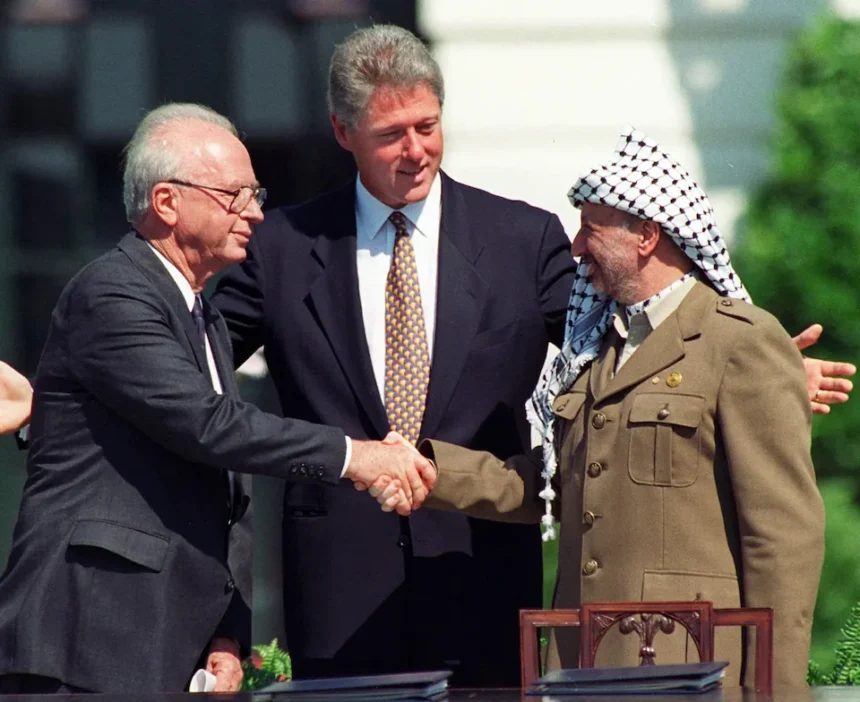

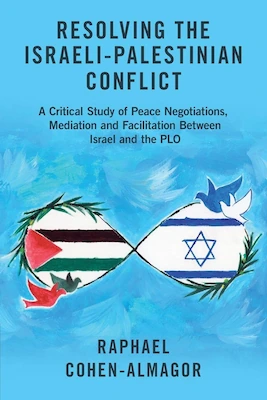
Raphael Cohen-Almagor’s Resolving the Israeli-Palestinian Conflict: A Critical Study of Peace Negotiations, Mediation and Facilitation Between Israel and the PLO (Cambridge University Press, 2026) is the result of research begun in 2013. It draws on archival work in several countries and on more than one hundred interviews with negotiators, mediators and officials from ten countries and the United Nations.
The book examines three moments in the peace process: the Oslo Accords, the 2000 Camp David summit and the negotiations between Mahmoud Abbas and Ehud Olmert. It then turns to what future negotiations would require and sets out the author’s own proposal for resolving the conflict.
In this interview, I asked Cohen-Almagor about the ideas behind the book, the evidence it relies on, and the choices he makes in his analysis and his proposal.
1. Your framework rests on Rawls, and you write that basic rights should not be subject to political bargaining. Yet your plan asks both sides to give up claims each regards as just. How do you reconcile an uncompromising conception of justice with the compromises a settlement requires? And how does a veil of ignorance that hides nationality address a conflict whose substance is national identity?
Justice is the paramount value, the cornerstone upon which liberty, equality, tolerance and peace depend. A genuinely just system inherently encompasses them all. Justice is the first virtue of social institutions, just as truth is of systems of thought. Rawls’s framework helps distinguish between principles of justice that should not be sacrificed for political convenience and the compromises that negotiations inevitably require. Basic rights should not be subject to political bargaining or subordinated to calculations of social utility.
Neither should they be compromised merely because doing so might appear to produce short-term advantages. Applied to the Israeli–Palestinian conflict, this means that a peace agreement cannot be considered just simply because it ends violence or satisfies the immediate interests of political leaders. It must also respect fundamental rights, human dignity, and the equal moral standing of Israelis and Palestinians.
Crucially, this does not mean that every claim advanced by either side must be accepted in full. The distinction is between protecting basic rights and negotiating over the political arrangements through which competing national aspirations are accommodated. A sustainable settlement requires compromise over political means and arrangements, while maintaining principled limits on what may legitimately be traded away. Compromise is the attempt to realise justice under conditions in which legitimate interests and aspirations conflict.
The Israeli-Palestinian conflict is fraught with ideological claims, misconceptions and biases that cloud participants’ ability to fully appreciate each other’s claims. Rawls’s veil of ignorance offers a valuable analytical tool for this purpose. It asks us to consider the principles governing a political settlement without knowing which position we ourselves would occupy.
Applied to this conflict, we would not know whether we would be born Israeli or Palestinian, Jewish or Arab, religious or secular, a member of a national majority or minority, or someone whose family had experienced displacement, violence, or insecurity. This exercise does not require us to erase national identity or deny its importance. Rather, it challenges us to consider whether the principles we defend would remain acceptable if we did not know which national community would benefit from them and which would bear their costs.
Camp David failed because the conditions for a successful agreement had not been adequately established.
National identity is central to the conflict, but it should not determine whose rights count more. Both sides have valid and legitimate concerns. The veil of ignorance helps expose the partiality of arguments that treat one people’s security, dignity, historical attachment or self-determination as inherently more important than those of the other. It encourages both sides to consider reciprocal principles: security without domination, self-determination without the denial of another people’s rights, and recognition of historical suffering without making that suffering a justification for perpetuating injustice. Such understanding is crucial for finding compromises.
Justice, therefore, is a necessary foundation. Justice does not mean justice only for the Palestinians, or only for the Israelis. A common sense of justice is essential for moving forward. A settlement cannot resolve every historical grievance or satisfy every national aspiration. It can, however, establish fair principles, protect fundamental rights, and create political arrangements in which both peoples can live with dignity and security. Justice is the first virtue of peacebuilding because, without it, an agreement may suspend conflict temporarily but will lack the legitimacy and mutual recognition required for lasting peace.
2. Your evidence rests largely on interviews with negotiators. You acknowledge the limits of that method, including hindsight and the tendency to magnify one’s own role, and you note that you reached fewer Palestinian voices than you wanted. Mahmoud Abbas did not grant an interview. How did you weigh conflicting accounts, and does this imbalance affect your conclusions about where responsibility for failure lies?
I did not treat any individual account as definitive. The book does not rest on the testimony of any single participant. I conducted more than 100 interviews with extensive archival work in Israel, the United Kingdom, the United States and Norway. I compared participants’ recollections with documentary evidence, media accounts, secondary literature, contemporary records and other accounts of the same events. Where interpretations conflicted, I sought to establish what the evidence could substantiate, and distinguish factual disagreements from differences in interpretation.
Leaders must assess imperfect proposals, explore alternatives and make difficult decisions when opportunities arise.
The imbalance in Palestinian representation is a genuine limitation, and I would have welcomed the opportunity to interview Mahmoud Abbas. His perspective would have been particularly valuable in examining the Palestinian leadership’s calculations, internal constraints and assessments of the proposals put forward during negotiations. I do not claim that my research captures every dimension of the decision-making process.
Nevertheless, this limitation does not invalidate the study’s central conclusions. I interviewed people who were very close to him, including his senior advisors whom he sent to negotiate with Israel. The book examines the conduct of negotiations, the proposals exchanged, the political constraints facing both leaderships, and the wider circumstances in which decisions were made.
Nor do I regard responsibility for failure as exclusive to one side. Responsibility varied across negotiations and stages of the peace process. My aim is to understand why initiatives that generated genuine opportunities for progress repeatedly failed to produce a durable agreement and what future negotiators can learn from those failures.
3. You hold that responsibility for the failure of the peace process lies with Israel, the Palestinian Authority and the mediators. For the 2000 Camp David summit, which carried the most weight? How do you answer readers who regard “we offered, they refused” as essentially accurate, and readers who point out that, as you note, the Israeli proposal infringed on Palestinian territorial contiguity?
Responsibility for the failure of Camp David in July 2000 cannot be assigned to one party alone, although the parties and the mediator bore different responsibilities. I contend that all three delegations bear significant responsibility for the summit’s disappointing outcome. The gaps between the Israeli and Palestinian positions were simply too vast to be bridged within the constrained two-week timeframe allotted by the American mediators. At the heart of the impasse was the issue of Jerusalem, particularly its religiously significant sites.
The summit ultimately failed because neither side was willing or politically able to make the painful concessions necessary for a historic compromise. Even in the final moments of negotiation, the Palestinian leadership insisted on the partition of Jerusalem and full, unconditional sovereignty over the Temple Mount, positions the Israeli delegation could not accept in full. This mutual rigidity underscored the depth of mistrust and the enduring complexity of the conflict.
The summit was convened before sufficient groundwork had been completed. Fundamental questions remained unresolved, mutual trust was weak, and the leaders had not adequately prepared their constituencies for the compromises that an agreement would require. President Bill Clinton deserves credit for his commitment to peacemaking, but the American mediation was weakened by the decision to convene a high-stakes summit without first narrowing the differences sufficiently. I think Clinton very much wanted the summit without carefully thinking of the consequences of a failure. Moreover, the Americans alienated major decision-makers in the Palestinian delegation.
Settlements were and remain a major obstacle because their expansion alters the territorial and political conditions under which a viable Palestinian state might be established.
To those who argue that “we offered, they refused”, I would say that this formulation captures an important part of the Israeli account but oversimplifies the negotiations. Israel made proposals, and the Palestinian leadership did not accept them. Yet the existence of an offer does not, by itself, establish that the offer provided an adequate or viable basis for an agreement. We must examine its substance, the circumstances in which it was presented, the outstanding differences, and the parties’ understanding of what acceptance would entail. The Palestinian leadership had legitimate concerns about sovereignty, territorial integrity, Jerusalem and refugees. These concerns cannot be dismissed simply by pointing to the fact that proposals were made.
At the same time, recognising the shortcomings of Israel’s proposals does not mean that the Palestinian leadership was free of responsibility. Leaders must assess imperfect proposals, explore alternatives and make difficult decisions when opportunities arise. The question is whether the parties could have used the negotiations to bridge their differences rather than allowing them to become insurmountable. Arafat was not interested in doing this. He did not truly engage in the talks and thought the summit was designed to trap him. He did not trust the Americans.
My conclusion is that Camp David failed because the conditions for a successful agreement had not been adequately established. The parties had not resolved the most difficult issues, the summit created pressure without sufficient preparation, and the mediation did not overcome the underlying mistrust. The lesson is not that one side offered and the other refused. It is that successful peacemaking requires viable proposals, political preparation, credible mediation and a willingness to address the other side’s fundamental concerns.
4. You argue that Abbas should have signed Olmert’s 2008 offer. You also write that every Israeli government expanded the settlements, that neither Barak nor Olmert halted the project, and that settlements are a major obstacle to peace. Your sources add that Olmert was politically weakened and under investigation. Why was signing the right decision when the prime minister making the offer could not deliver and presided over continuing settlement growth? And what would make a settlement freeze credible now, given your remark that Israel and the Palestinian Authority are “either unwilling or unable” to stop it?
I argued that Abbas should have signed Olmert’s 2008 offer because it represented a significant opportunity to advance negotiations towards a two-state agreement. I acknowledge that the agreement was not flawless and that Olmert was not politically secure. Nevertheless, signing a peace agreement is a milestone. It carries declarative and diplomatic weight.
In diplomacy, leaders rarely receive proposals that meet all their demands or come from counterparts whose political futures are assured. The relevant question is whether an offer provides a sufficiently promising basis for further negotiation, and whether rejecting it forecloses opportunities that may not return. I think Abbas missed an historic opportunity to receive in writing, from an Israeli prime minister, a pledge to build the foundations for a two-state solution.
Olmert was politically weakened by investigations, and settlement expansion continued during his tenure. These were serious limitations that Abbas had reason to consider. But Abbas could have expressed agreement in principle. Such a response would have preserved diplomatic momentum, established a framework for further negotiations, and made it harder for either side to retreat without political cost.
Confederation must be voluntary and based on the consent of a sovereign Palestinian state.
Settlements were and remain a major obstacle because their expansion alters the territorial and political conditions under which a viable Palestinian state might be established. A credible settlement freeze today would require more than a declaration of intent. It would need a clearly defined scope, including a position on construction within existing settlements and in areas intended to form part of a future Palestinian state; transparent monitoring; a timetable; and consequences for non-compliance. International actors could support verification and provide diplomatic and economic incentives; they cannot substitute for political decisions by the parties themselves.
My observation that presently Israel and the Palestinian Authority are either unwilling or unable to stop settlement expansion points to the central difficulty: commitments are meaningful only when accompanied by the political will and institutional capacity to implement them. Credibility would have to be demonstrated through verifiable action.
Negotiations need to connect political agreement with enforceable implementation. A viable peace requires both sides to recognise the costs of continued unilateral action and to establish mechanisms that prevent domestic opponents from undermining the process. While a positive process might not be feasible at present, I am hopeful that new leadership in Israel and Palestine, under different circumstances, may lead Israel and Palestine to the path of reconciliation.
5. You propose that West Bank elections be open only to parties that recognise Israel’s right to exist and renounce violence. You have written about the “democratic catch,” the tension between protecting democracy and preserving its liberal values. Does restricting candidacy not reproduce that problem, and who would decide, and enforce, which parties qualify?
The central challenge of democratic peacebuilding is to prevent extremists from using democratic institutions to undermine the very possibility of peaceful coexistence. Previous Israeli–Palestinian peace initiatives were repeatedly derailed by violent spoilers, Palestinians and Israelis, who sought to pre-empt reconciliation. Their success demonstrates that peace processes cannot rely on goodwill alone. Both Israelis and Palestinians have an interest in ensuring that political violence does not determine their future or give extremists an effective veto over negotiations.
This is the essence of what I call the “democratic catch”: democracy must protect political freedom while preventing those who reject its fundamental principles from exploiting democratic institutions to destroy them. Liberty and tolerance are indispensable democratic values, but they are not absolute. They are not without limits. A democracy that refrains from defending itself against organised violence and the destruction of democratic rights may ultimately facilitate its own demise. At the same time, measures designed to protect democracy can themselves become instruments of exclusion or repression. Thus, restrictions on political participation must be carefully defined, reasonable, justifiable, proportionate, transparent and subject to independent review.
A Palestinian–Jordanian confederation would be viable only if it strengthens, rather than dilutes, Palestinian independence and serves Jordan’s interests without destabilising the Kingdom.
The question of eligibility for West Bank elections must be approached in this spirit. Requiring parties to recognise Israel’s right to exist and renounce violence raises legitimate concerns about political exclusion and who has the authority to determine which views are permissible. Such conditions must not become a convenient means for incumbents to silence peaceful opposition or disqualify challengers. Nor should political disagreement, criticism of Israel, or opposition to particular peace proposals be conflated with support for violence.
The Palestinians have been deprived of a meaningful opportunity to renew their political leadership through competitive elections for far too long. Their political future must be determined by Palestinians themselves, through free, fair and credible elections, certainly not imposed by Israel or external powers, and not monopolised by a narrow political elite. Palestinians should have the principal role in establishing the electoral rules and determining, through legitimate institutions, how those rules are applied.
To safeguard both democracy and the prospects for peace, eligibility criteria should be established through an inclusive Palestinian political and legal process, applied equally to all parties, and enforced by an independent electoral body with access to judicial review. A similar scrutinising system exists in Israel. The criteria should focus on demonstrable conduct and commitments, particularly the rejection of violence and terror, rather than ideological conformity. Decisions to exclude a party should require clear evidence, reasoned justification and an effective right of appeal.
The objective is not to restrict Palestinian democracy for the convenience of Israeli governments. It is to enable Palestinians to choose their representatives while ensuring that electoral competition does not become a vehicle for organised violence or the destruction of the political conditions necessary for peace. Peace is a vital Palestinian interest. Peace would guarantee continued Palestinian sovereignty. A democratic system must protect both the right to participate and the right of the population to live without intimidation and violence. The challenge is to draw that boundary without allowing those entrusted with enforcing it to abuse their power.
6. Your plan ends with a Palestinian-Jordanian confederation, negotiated four years after the Palestinian state is established. Your interviews show Jordanian reluctance, and the polls you cite show Palestinian support falling from 55 per cent in 2013 to 42 per cent in 2016. Why is confederation preferable to two fully independent states, and how would it avoid becoming Jordan speaking for the Palestinians?
The confederation’s potential advantage is that it could preserve Palestinian statehood while providing a framework for deeper cooperation than conventional interstate relations. Whether it is preferable would depend on the terms negotiated and the freely expressed wishes of both populations.
I propose a Palestinian–Jordanian confederation not as a substitute for Palestinian statehood, but as a possible next step after an independent Palestinian state has been established. Its rationale is practical: Palestinians and Jordanians share close historical, social and economic ties, and cooperation could strengthen Palestinian institutions, expand economic opportunities, and improve regional security. A confederation could facilitate collaboration in infrastructure, education, trade, water, agriculture, transport and scientific research, while enabling both societies to benefit from shared resources and expertise.
Jordan can provide the backbone for Palestinian independence. The Hashemite Kingdom is an island of stability in a torn and highly complicated region. The idea of a confederation does not aim to threaten the Kingdom or weaken it. The confederation depends on the goodwill of all parties involved. It is not based on coercion. It is not meant to cause an influx of Palestinians from the West Bank to Jordan, destabilising its delicate population balance. It is not intended that Jordan become the representative of the Palestinians against their will. Political and constitutional issues should be resolved by discussions and negotiations.
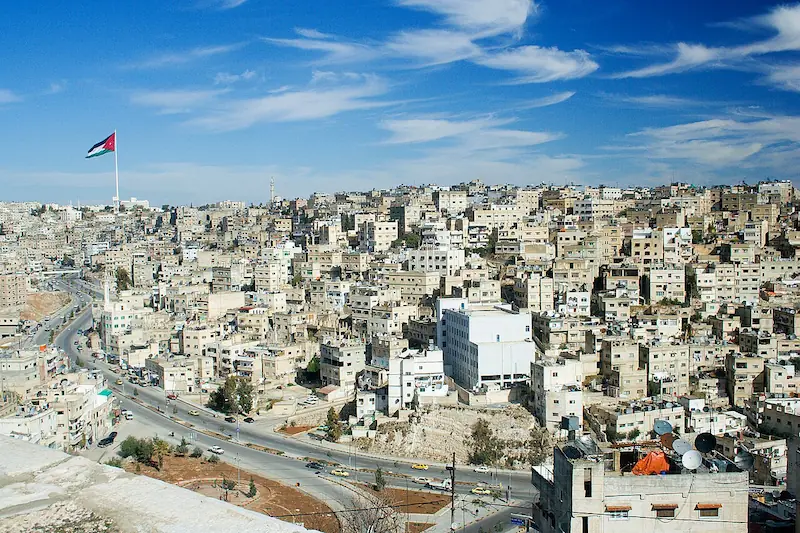
Jordan has a GDP per capita of around $4,255, reflecting its diversified economy and substantial foreign aid. In contrast, Palestine’s GDP per capita hovers around $2,747. In Jordan, the overall unemployment rate is around 15%; in Palestine, the unemployment rate is significantly higher, ranging between 25 and 30%. In Jordan, approximately 15.7% of the population lives below the poverty line, reflecting ongoing efforts by the government to address this issue. In Palestine, the situation is more challenging, with around 29.2% of the population living below the poverty line.
The economic disparities between Jordan and Palestine underscore both the potential benefits and the challenges. Jordan could contribute institutional experience, established security structures and access to regional networks; Palestine would bring its own human capital, entrepreneurial capacity and economic potential. International assistance would be essential to invest in infrastructure, build institutions and support sustainable development.
The integrated Jordanian-Palestinian economy will leverage the respective strengths of each society, including labour, entrepreneurial capacity and natural resources. Free movement of people between the East and West Banks will be facilitated, allowing Jordanians and Palestinians to work, travel and engage in cross-border economic activities. International assistance will play a crucial role in supporting the confederated economy, particularly in infrastructure development, institutional capacity-building and investment promotion. Such support would be essential to ensure the long-term viability of the confederation and to transform it into a model of regional cooperation and sustainable development.
I believe that the Israeli–Palestinian conflict can be resolved, and that one day it will be. Israel cannot live by the sword forever, and Palestinians cannot be expected to live under occupation indefinitely.
Yet economic advantages alone cannot justify confederation, and the model must be assessed against the political aspirations and preferences of both peoples. The concern that Jordan might speak for Palestinians is fundamental. Confederation must be voluntary and based on the consent of a sovereign Palestinian state. My proposal is more egalitarian than King Hussein’s federation plan of March 1972.
Palestine and Jordan would retain separate governments, parliaments and prime ministers, with Palestine’s capital in East Jerusalem and Jordan’s in Amman. The Palestinian government and parliament would control Palestinian domestic affairs. Shared institutions would coordinate matters of common interest, while decisions affecting Palestine would require meaningful Palestinian participation and consent. Jordan could contribute to regional diplomacy and security, but it must not replace Palestinian political representation or undermine Palestinian self-determination.
Thus, my proposed framework envisages joint mechanisms for economic cooperation, judicial coordination and security, including arrangements for the Jordan Valley and the protection of borders. These are proposals for negotiation, not predetermined terms. Questions concerning the Hashemite monarch’s role, joint security command, foreign policy and the administration of holy sites would require particularly careful discussion. No arrangement would be sustainable if Palestinians perceived it as a means of transferring their sovereignty to Amman, or if Jordanians believed it threatened their own political stability.
My conversations with Jordanian officials reinforced the importance of sequence and consent. While they did not reject the idea of a Jordanian-Palestinian confederation, they emphasised that a Palestinian state must come first. This position echoed King Abdullah II’s insistence that Palestinians and Jordanians should decide the nature of their relationship only after Palestine exists as a state. Ehud Olmert similarly told me that Jordan would not contemplate an arrangement that jeopardised Palestinian sovereignty.
I recognise that Jordanian officials have been cautious and that Palestinian public support for confederation has fluctuated. My argument is not that either population should be persuaded to accept a predetermined constitutional structure. It is that the option should remain open for democratic consideration once Palestinian statehood has been achieved. Consent needs to be earned through consultation, transparency and credible guarantees.
A Palestinian–Jordanian confederation would be viable only if it strengthens, rather than dilutes, Palestinian independence and serves Jordan’s interests without destabilising the Kingdom. It must be negotiated freely, supported by both populations and sustained by substantial investment. The objective is to explore whether voluntary cooperation between two sovereign states could offer greater security, prosperity and regional stability than either could achieve alone.
7. You write that the option of a single Palestine in the West Bank and Gaza became “much more problematic” after 7 October 2023, and that Jordanian officials told you, before that date, “Palestinian state first, and then we shall see.” Does the war change the sequence you propose, and should Gaza be resolved before or after the creation of the state?
The war has reinforced my view that the sequence matters, and it has also made a viable resolution more urgent and more difficult to achieve. Since Hamas seized control of Gaza in 2007, I have been sceptical of proposals that treat the West Bank and Gaza as though they were already a single, politically integrated territory. They are geographically separated and have developed different political institutions, laws and educational systems.
The rivalry between Hamas and the Palestinian Authority has further deepened this division. Hamas’s violent takeover of Gaza, its continued rejection of Israel’s right to exist, and its commitment to armed struggle have raised serious questions about the security arrangements required for a unified Palestinian state. I found proposals that spoke of a bridge, or a tunnel, between the West Bank under the Palestinian Authority, and Gaza under Hamas, passing through Israel, horrifying and impractical.
Peace is possible, and the experience of other nations gives us every reason to believe that it can be achieved.
This option of one Palestine in the West Bank and Gaza became much more problematic on 7 October 2023. The terror attack Hamas launched on Israel was a game-changer for Palestine, for Israel and for other national and international players, as well. The ferocity and scale of the attack, the trauma it has inflicted on Israeli society and the dramatic impact it has had on its sense of security, all were unprecedented. The brutal attack confirmed, as if confirmation was necessary, that Israel must take fanatics most seriously and not simply say “there will always be spoilers” and “we’ll have to deal with them at the time”. Zealots like Hamas change the matrix of the conflict.
The scale and brutality of the assault profoundly reinforced the imperative of preventing armed groups from using territory under their control to launch further attacks. Israel’s subsequent military campaign in Gaza caused catastrophic Palestinian suffering, mass displacement and extensive destruction. Traumatised by Hamas’s attack, Israel responded with an unprecedented assault that thrust the Gaza Strip into profound trauma of its own.
The resulting trauma on both sides has deepened mistrust and made political reconciliation harder. Yet it would be a mistake to conclude that Gaza can simply be excluded from a lasting settlement. The West Bank and Gaza belong to one Palestinian people, bound by family, social and national ties. Abandoning Gaza altogether would undermine the legitimacy and viability of any peace agreement.

Thus, my proposal distinguishes between the political conditions required for Palestinian statehood and the practical arrangements needed to integrate Gaza into that state. Hamas cannot be allowed to retain an independent armed capacity that undermines Palestinian sovereignty, threatens Israel and undermines a negotiated settlement. Gaza needs legitimate and effective Palestinian governance, security arrangements that prevent renewed attacks, and a credible path towards political reconstruction. These conditions are essential.
I do not believe that every aspect of the Palestinian state must be resolved before statehood can be established. The objective should be to establish a viable, sovereign Palestinian state with a legitimate government committed to peaceful coexistence, while negotiating the conditions under which Gaza can be securely and effectively incorporated. A phased process is necessary. As long as the Gazan government remains hostile and terrorist, the border with Israel will remain sealed and Gaza cannot be part of the two-state solution. If relations improve, the parties could work together to integrate the two territories into a single, contiguous Palestinian state.
Only after the necessary political and security conditions are met should a secure corridor, potentially a tunnel or another agreed arrangement, connect the West Bank and Gaza. It should permit the safe movement of people and goods under Palestinian authority, with mutually agreed safeguards against its use for violence. The arrangement must protect Israel’s security without turning the corridor into a mechanism for controlling Palestinian movement indefinitely.
The Hamas-Israel War of 2023-2025 has made the path more arduous. A durable settlement must acknowledge Israeli security fears and Palestinian aspirations for freedom and statehood. Neither can be achieved by denying the other. The essential task is to translate these principles into a phased process that combines legitimate Palestinian governance, effective security guarantees, reconstruction and a clear commitment to territorial and political unity.
8. You describe yourself as a proud Zionist and adopt Rawls’s veil of ignorance to take account of your own sympathies. At what point in the research did the veil most clearly force you to revise a view you held as a Zionist?
My encounter with the realities of the occupation began long before I conceived of writing this book. During the 1980s, I visited the West Bank and was deeply disturbed by what I witnessed. I found it profoundly troubling that Jews, whose history is marked by generations of persecution and injustice, could be part of a system in which another people experienced domination and the denial of basic rights. My belief that there is a need for a home for the Jewish people did not disappear; it prompted me to become a peace activist and seek a just solution that would consider the Palestinian right to self-determination.
During my MA studies at Tel Aviv University I studied Rawls for the first time. I continued to engage with Rawls’s impressive scholarship at the University of Oxford, when I was writing my doctorate on the boundaries of liberty and tolerance. Rawlsian theory features in many of my writings, most recently in my book Just, Reasonable Multiculturalism (2021). The veil of ignorance provides an analytical framework to accentuate a solution.
Behind the veil of ignorance, nobody would like to live, and accept, occupation. I do not think that any unjust solution could survive for long because people on the losing side would rebel against it. Grievances that are ignored do not simply disappear; they can deepen resentment, undermine legitimacy and fuel resistance. The solution must be just for both sides, not only for the stronger party. Thus, I have been thinking about these issues for a very long time and have put these ideas also in my new book.
I believe that the Israeli–Palestinian conflict can be resolved, and that one day it will be. Israel cannot live by the sword forever, and Palestinians cannot be expected to live under occupation indefinitely. Both peoples have legitimate rights and national aspirations. Their claims conflict, but they are reconcilable. The challenge is to find a political settlement that recognises the rights, security and dignity of both peoples.
In my book, I draw on the experience of Sweden and Denmark to illustrate why even deeply entrenched conflicts can be overcome. I lived in Lund, in Skåne, a region that was once part of Denmark. For roughly two centuries, from the sixteenth to the early eighteenth century, Sweden and Denmark fought repeated, often bloody wars over territory and regional supremacy. Yet eventually, they moved beyond their history of hostility. Today, people travel freely between the two countries, and the busy train connection between Lund and Copenhagen is a routine expression of their peaceful coexistence. Cooperation has replaced warfare, and the old conflicts have largely receded into history.
Sweden and Denmark have not forgotten their past; they have learned to live beyond it. Their experience demonstrates that historical enmity need not determine the future. If two neighbouring peoples who fought for centuries could build a peaceful relationship based on shared interests and mutual respect, Israelis and Palestinians can do so too. It will require courageous leadership, a willingness to compromise, and recognition that neither people can secure a lasting future by denying the other’s legitimate aspirations.
Peace is possible, and the experience of other nations gives us every reason to believe that it can be achieved. I remain hopeful. As I have often said, one scratch on a wall is just a scratch; millions of scratches can cause the wall to crumble. My book is one such scratch, offered in the hope that, together with countless others, it may help break down the barriers that stand in the way of peace.