

People are often thought to be kind to their own group (the so-called ingroup) but unkind to people from other groups (so-called outgroups). Indeed, it has been suggested that “ingroup love” goes hand in hand with “outgroup hate.”
My recent study, based on data from 743,402 people in 121 societies, suggests otherwise. When people do not have to choose between their own group and other groups, those who are kind to the ingroup tend to be kind to the outgroup as well.
Although the positive relationship between ingroup and outgroup prosociality appears in every studied society, its strength differs between societies.
This matters for how we think about prejudice, discrimination, and conflict between groups. If kindness toward one’s own group came at the cost of kindness toward others, efforts to promote kindness toward one’s own group could harm other groups. The findings of the study tell a more hopeful story. Ingroup love does not imply outgroup hate. If anything, it goes together with outgroup love.
Is Prosociality Bounded by Group Membership?
Humans have a strong capacity for prosociality, that is, for behaviors that benefit others, such as trusting, helping, and sharing. But it is often thought that this prosociality is mostly limited to members of one’s own group, such as one’s own nationality or religion.
The idea that humans might even have a tendency to be unkind to outgroups comes from the view that people want their own group to do well compared with other groups. Promoting the relative status of one’s own group can be achieved by helping one’s own group, but also by disadvantaging other groups.
People who are unkind to foreigners tend to be unkind to people from their own country too.
If people thus care only about the relative status of their own group, it could make sense that ingroup love goes together with outgroup hate.
The studies that support this idea typically examine situations in which people can only help their own group at the expense of the other group. Think of a task in which participants have to divide a sum of money between a member of their own group and a member of another group. Every coin given to the ingroup is a coin the outgroup does not receive.
In such a design, a negative relationship between the ingroup and outgroup is built in. Hence, these studies cannot tell us whether people who are kind to their own group are also kind to other groups. To study this, people need the opportunity to behave prosocially toward both groups, without having to choose between them. This is where my study comes in.
Testing Ingroup and Outgroup Prosociality Worldwide
In my study, I examine situations in which people make separate decisions about the ingroup and the outgroup. This allows me to see whether the two forms of prosociality are positively or negatively related. I do so across six pre-existing datasets that together cover 743,402 individuals in up to 121 societies.
The datasets measure different forms of prosociality, from trust and tolerance in surveys to cooperation, giving, and contributions in economic games. The datasets are also diverse in the types of ingroups and outgroups they include.
Kindness toward one’s own group need not come at the expense of other groups.
For example, the ingroup may consist of people from the same country, ethnicity, religion, or local area, whereas the outgroup consists of people from a different country, ethnicity, religion, or from outside the local area.
This diversity makes it possible to test whether the relationship between ingroup and outgroup prosociality holds across very different societies, forms of prosociality, and types of groups.
Ingroup Love Goes Together with Outgroup Love
The results point clearly in one direction: the more prosocial people are toward their own group, the more prosocial they tend to be toward other groups. People who trust, cooperate with, or give to members of their own group also tend to do so with members of other groups. This positive relationship appears regardless of which form of prosociality and which group distinction is examined, and is present in all 121 of the examined societies.
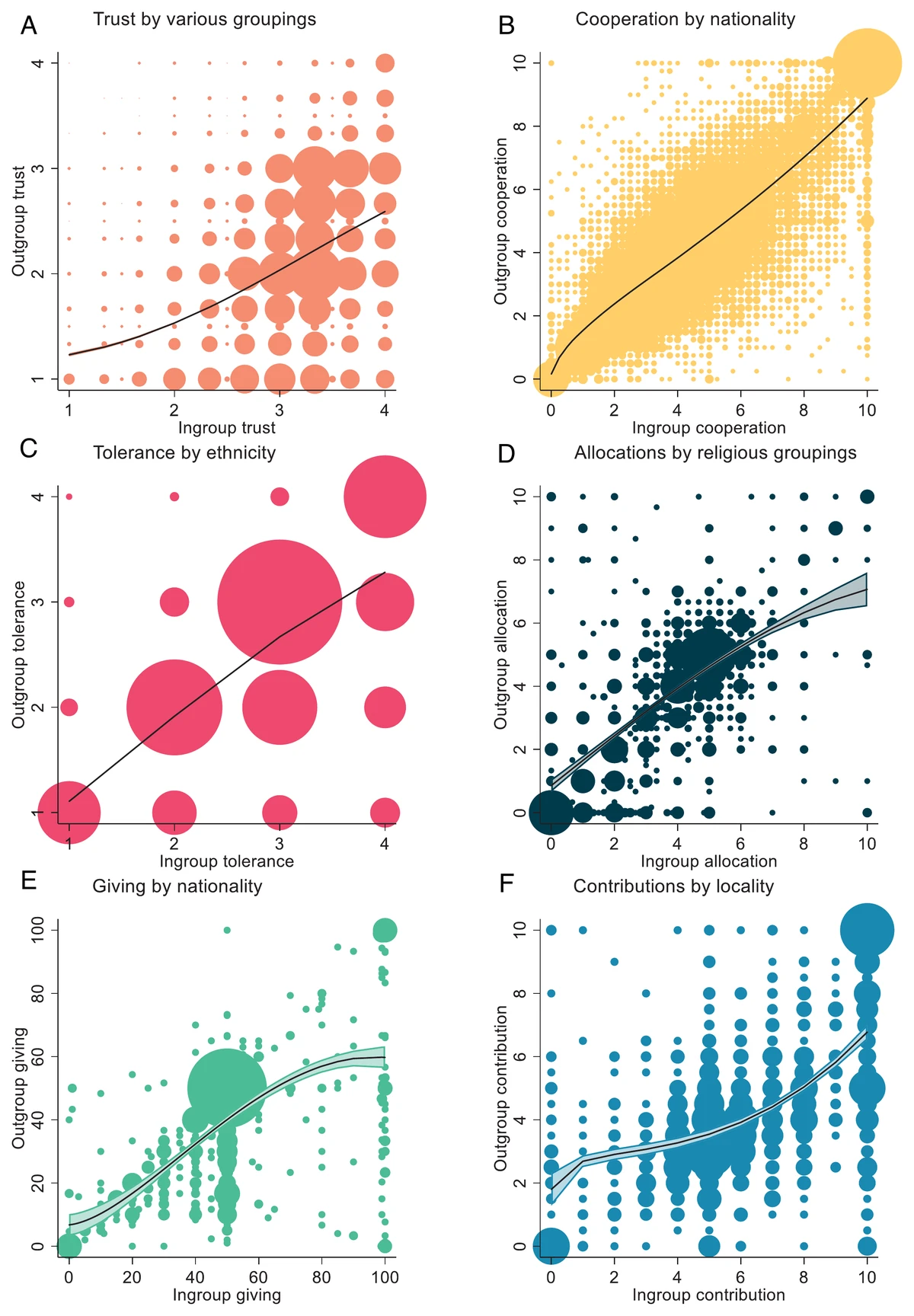
This does not mean that people treat both groups equally. On average, people are still somewhat more prosocial toward their own group than toward other groups, a pattern known as ingroup favoritism. Yet, ingroup favoritism and a positive relationship between ingroup and outgroup prosociality can exist side by side. That is, people who are more prosocial toward their own group are also more prosocial toward other groups, even if they remain a bit more prosocial toward their own group.
In sum, once people no longer have to pick a side, the link between ingroup love and outgroup hate disappears. Those who show “love” for their own group tend to show it for other groups too.
Moving Beyond Zero-Sum Situations
These findings have implications for relations between groups. Intergroup conflict is known to be common where the goals of groups are opposed. Think of a war, where one country’s territorial gain is another country’s loss, or an election, where every vote won by one party is a vote lost by its rivals.

In such zero-sum situations, ingroup love and outgroup hate may indeed go hand in hand. Yet, studies of such situations say little about how people behave when one group’s gain is not automatically another group’s loss. My results suggest that removing the zero-sum character of such situations may promote prosociality toward everyone.
Outgroup Haters Are Not Ingroup Lovers
The findings also shed new light on people who are unkind to outgroups. It is sometimes thought that people who are hostile to foreigners are especially kind to their compatriots. Hostility toward outgroups is then seen as the flip side of strong loyalty to the ingroup, a view often referred to as parochialism. Yet, the findings do not support this view. People who are unkind to foreigners tend to be unkind to people from their own country too.
Hence, the idea that “outgroup hate” goes together with “ingroup love” also finds no support in the data. Hostility toward other groups seems to reflect a broader lack of prosociality, rather than a strong commitment to one’s own group.
Differences Between Countries
Although the positive relationship between ingroup and outgroup prosociality appears in every studied society, its strength differs between societies. For example, the relationship tends to be stronger in more individualistic societies and in richer societies.
In contrast, it tends to be weaker in societies with stronger extended-family ties, and where favoring relatives and personal connections (nepotism and particularism) is more common. However, these are correlational findings. More research is needed to establish whether these characteristics cause the differences between societies.
An Optimistic Message
Altogether, the findings offer an optimistic message for relations between groups. Kindness toward one’s own group need not come at the expense of other groups. The challenge is to create situations in which people do not have to choose between them. People who wish to explore the research further can read the full paper, which is openly available.