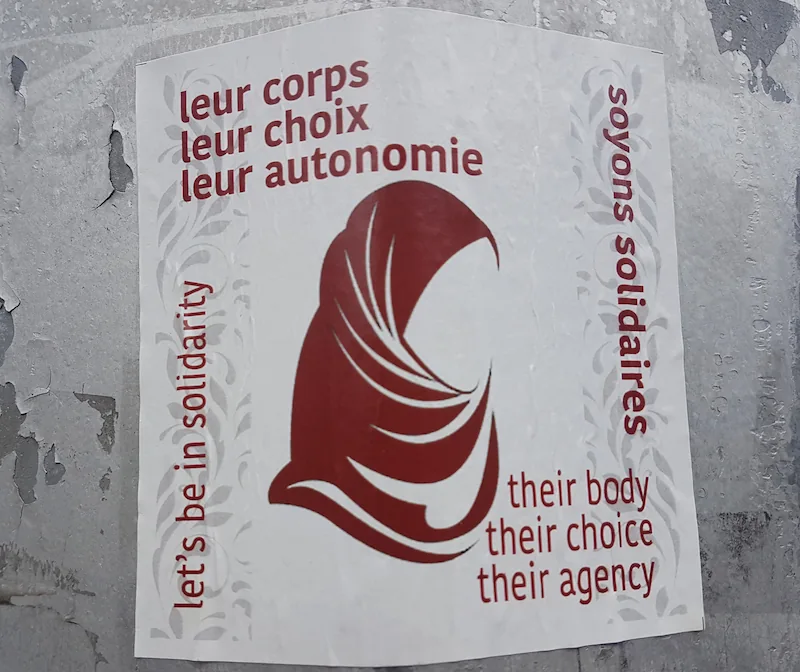
In recent years, political leaders in the North Atlantic world have stressed the importance of buttressing “secularism,” often framed as a separation of undesirable religion from a shared public and political sphere, in response to what are imagined as growing diversities, radicalism, or even homegrown terror.
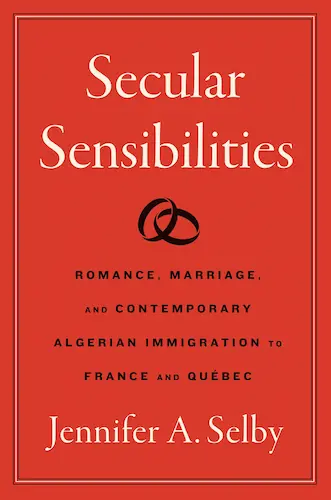
Governments in France and Québec, Canada have focused their legislative efforts on restricting certain religious symbols, namely those that are expressions of modesty among Muslim women. Secular Sensibilities asks, in contradistinction to these restrictions, how are desirable secular bodies and sensibilities imagined? What are the bodily, moral, affective and emotional expectations commonly attached to an idealized secular body?
Contemporary secular regimes in France and Québec are increasingly demanding of visible markers to distinguish “good” secular subjects from suspicious religious ones.
The book takes a “shadows” or indirect approach to map secular sensibilities ethnographically and binationally among interlocutors of Algerian origin who live outside of Paris, France and in Montréal, Québec, in their engagements with these states at the moment of civil marriage. I also traveled twice with interlocutors to Algeria on marriage trips. Differing socioeconomic contexts and migration histories shape the individuals of Algerian origin who live in this Parisian suburb and in Montréal. To locate marriage practices more pointedly in the broader historical matrices of colonialisms and coloniality, I only interviewed participants of Algerian origin.
On the surface, the contact zone of civil marriage might seem innocuous, but these “moments of contact” are revelatory.
Laws in France that curtail “love fraud” and in Canada that are aimed against “bad faith marriage” have sought to reduce fraudulent family reunification through marriage.
State scrutiny of emotional, sexual and financial intimacies is especially sharp for couples whose relationships are arranged and for whom citizenship is at stake.
In both France and Canada, bureaucrats investigate marriages between citizens and migrants for sincerity, assessing evidence like photographs, text messages, wedding rituals or comportment and, in France, through unannounced home visits. For some of the Algerian-origin couples I interviewed, romantic love becomes a performance, aligning with what Lauren Berlant called the national fantasy of “intimate citizenship.”
For example, in July 2016, I had the opportunity to attend the wedding of “Amel,” 25, to “Yacine,” 26, in Ghazaouet, Algeria. Amel was born in France and is a practicing Muslim. She described her union with this “traditional” transnational groom as “destined” (or, in Arabic, as mektoub). In its immigration laws aimed at family reunification of individuals outside the European Union, the French state assumes that Amel must be protected from the patriarchal religious practice that undergirds this union.
However, in my reading, more important for her in her desire for this transnational union was her cosmopolitanism rooted in her family’s ties to Ghazaouet. Her father and oldest brother also married women from that city; her maternal grandmother is Yacine’s parents’ next-door-neighbour. Desire for the Bled (Arabic for home country) cannot be reduced to religiosity; their union should be located in longstanding colonial circuits. Quijano’s thinking on the coloniality of power is a helpful tool to cast experiences of love and desire within these longstanding historical matrices of colonialism and secularism. Amel therefore complicates a liberal notion that romantic love is anathema to kinship, religiosity, or religious piety.
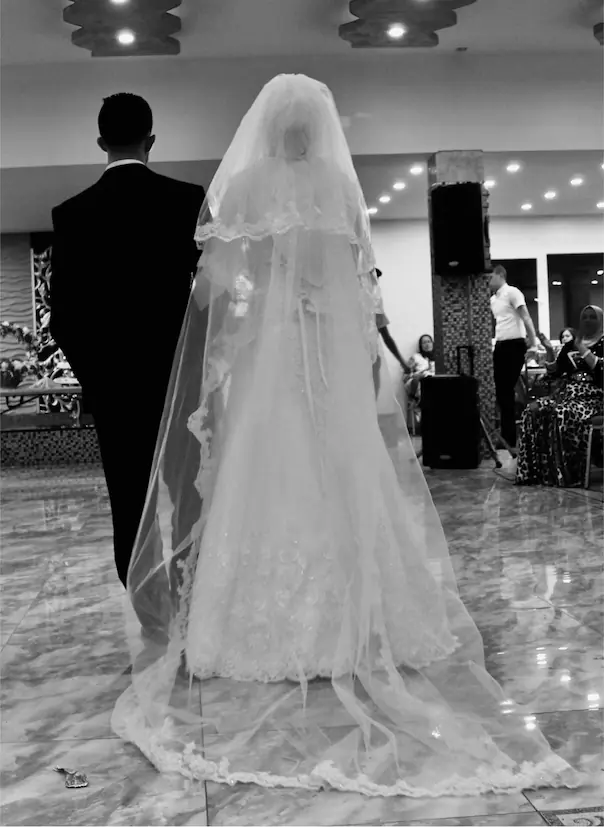
More specifically, and unexpectedly, drawing on the narratives of 187 interlocutors interviewed between 2011-2019, I see a French and Canadian/Québécois surveillance of love and romance in civil marriage as a subtle but significant articulation of “secular sensibilities.” Romance becomes a proxy for liberal values of individualism, free choice, and women’s sexual emancipation, all imagined as curtailed by “religion.”
In addition to state logics of suspicion cast upon often racialized non-nationals, performative expectations for romance in civil marriage also reflect pervasive (and pleasurable) consumer culture. There are no concerns for the acute consumerism or hetero-patriarchal rituals that also appear in many marriages, nor for the high incidence of divorce. Secularism is therefore not merely an institutional principle, but can also be read as embodied and emotional sensibilities that shapes how people love and perform belonging.
Therefore, in contrast to theorists of secularism who have suggested that a “secular body” is difficult to decipher – with a “very tenuous connection with observable behavior” or that the secular body speaks “in an ordinary and even critical voice”, with a posture that is “neutralish, cogitative, deflating, [and] always faintly condescending” – I show that something else is taking place: Contemporary secular regimes in France and Québec are increasingly demanding of visible markers to distinguish “good” secular subjects from suspicious religious ones. I develop the notion of secular sensibilities drawing on and extending previous work by Nadia Fadil, Nülifer Göle, and Schirin Amir-Moazami.
Secularism as an Episteme
Examining secularisms’ sensibilities means situating them beyond typical legal or normative definitions, and centring an epistemological plane that shapes what and how religion emerges. In the book I highlight three features of how laïcité is commonly framed in these two Francophone contexts:
First, as evident in their near-necessary imbrication with religion, secularisms in France and Québec hinge on a number of constructed binaries, including the idea of separate public and private spheres, of certain religious symbols as conspicuous and others as inconspicuous, with what is imagined as conservative or as liberal, and with a concomitant emphasis on a dualistic gender binary.
In France, and increasingly in Québec, secular legislation has been invoked as a response to political and religiously-framed terrorist violence.
Second, the assessment of appropriate secularism and its sensibilities in these contexts occurs primarily on a visual plane. This lens is reflected in the surveillance of outward religious symbols as reflections of either undesirable religiosity or desirable cultural heritage. I situate this monitoring of religious signs amidst longstanding French and Québécois/Canadian biopolitics, or the managing of populations. These assessments are focused on women’s bodies.
In France, Marianne from Eugène Delacroix’s 1830 painting, “Liberty leading the people” is idealized. With the Notre Dame cathedral smouldering in the background, Marianne’s liberation from clericalism and celebration of the République are evidenced through her exposed body. The secular body is drawn less sharply in Québec, but the rare-in-practice but ubiquitous-in-the-imagination niqab or face veil is a flashpoint in both contexts, where laws also prohibit them.
Lastly, the secular body is colour-blind, entrenching a normalized whiteness. Both French and Québécois leaders have denied that systemic racism exists and take a colour-blind approach that purports to see race as a neutral category, including in relation to secular legislation. Yet, as scholars have done elsewhere, these denials can be read as strategies of erasure that downplay racial inequality and racist practices. Secularisms therefore cannot be understood outside of whiteness.
Two Ethnographic Vignettes
Let’s turn to the heart of this book: its ethnographic data.
“It wasn’t a love marriage. We didn’t know each other. And we didn’t have a lot of time to get to know one another because the marriage came together really really quickly: two months from the proposal to the wedding. So, we weren’t, we didn’t know what to expect [at the French consulate in Oran, validating their marriage]” (Nawel, 28).
I open the book with this example because I see, Nawel, 28, as engaging with secular scrutiny before the French consulate in Oran, Algeria following her wedding. Nawel was born in Tlemcen, on the western edge of the country and already held French citizenship and was living outside of Paris to study when she agreed to an arranged marriage to “Khalid,” also from her hometown, also living near Paris.

Their marriage took place in a rented hall in Tlemcen, Algeria. Even if French citizenship was not at stake, their wedding certificate needed to be legitimized at the French consulate for their livret de famille. Nawel described how she took a great deal of care to do her hair in a chignon and make-up in “French styles” (wearing red lipstick and no dark eye liner) when they visited the French consulate, effectively – in my reading – internalizing state concerns with arranged marriages and consciously rendering her body “modern” or “secular.”
In so doing, Nawel sophisticatedly reads the French state at the consulate in a moment in which she is vulnerable. In their interview at the consulate, she did not yet know her husband well and worried that their arrangement might make state officials question the union’s legitimacy. Reading as Muslim makes this onus of performing appropriate secularism greater.
Secular sensibilities impact my male interlocutors somewhat differently. Across the Atlantic, Walid, 47, migrated alone to Montreal from Algeria with permanent residency in 2006. He sponsored Farida, who he met in a family arrangement, without issue in 2008.
Walid says that his rose-colored glasses about Québec darkened after Farida’s migration to Montréal. In 2013, the Parti Québécois proposed a “Charter of Québec Values” (Bill 60) that sought to ban all public servants from wearing conspicuous religious signs. Farida is non practicing but has worn a hijab since the 1990s, initially as a shield against Islamicist violence in Algeria. Walid explains that as the husband of a woman wearing hijab, he became aware that he was no longer a valued citizen in Québec. These politics made Walid physically and emotionally sick:
“You know, I think that if I had seen a psychologist [un psy], he would have told me I was depressed. I’m someone who follows the news, and this [news about Bill 60] made me sick.”
The figure of Marianne is especially expedient in promoting the idealized female secular body.
In that period, while pregnant with their second son, Farida fainted outside a grocery store. Walid was with her and called for an ambulance. He recalled being bewildered by the firefighters’ “stigmatizing questions” about their marriage as they attended to Farida: how did he meet his wife? Was theirs a forced marriage? Why did she not speak French as well him? Had he forced her to veil? How had he contributed to her fainting? He now regrets not calling them out on their dizziness-unrelated questions. He noted, “I was in such a state of panic that I just responded to their questions.”
The first responders’ slippage into intimate questions about their sexual lives resonates with the kind of questioning undertaken by French marriage commissioners. They read Farida’s physical vulnerability as reflecting Walid’s undesirable sexual politics. Like in France, secular-sexual sensibilities in Québec ignite pressure on racialized men, particularly those who are imagined (rightly or wrongly) as practicing Muslims, to clearly signal their promotion of an acceptable secular body, through their own habitus. A female partner wearing a hijab makes the onus higher for the performance of romance, even in a medical emergency.
Surveilling the Secular Body
Why are French and Québécois legal projects, including those I discuss related to curbing transnational marriage, increasingly prescriptive and demanding of proof of secularity – a clear legibility – on the body? In France, and increasingly in Québec, secular legislation has been invoked as a response to political and religiously-framed terrorist violence. In France, especially in the years following 2015, the invisible threat of home-grown terrorism is invoked by ubiquitous Vigipirate signs. “Vigipirate” is an acronym that can be translated as “Vigilant Surveillance.” A state of emergency deployed from 2015-2017 continues as a surveillance norm. In this context of fear and vigilance, racialized and religionized individuals are impelled to “prove” their secular belonging.
Infographics created by French and Québécois governments amidst this legislation are evocative of these concerns. Again, the idealized contours of secular bodies are more specific in France where there is a sense of a greater urgency to ensure secular sensibilities in the public sphere.
The figure of Marianne, to which I’ll return in a moment, is especially expedient in promoting the idealized female secular body. The secular body’s abhorrent foil is the face veil. Niqab-wearing women effectively block male seduction and a cis-hetero male gaze. Male seduction and chilvalry run counter to face veils. They also obscure problems of racial and economic inequality and falsely present themselves as markers of gender equality and civility.
Explore Books Written by Our Contributors
This government-issued poster, published following horrible terrorist attacks in November 2015, depicts “warning signs” of jihadist radicalization and captures this dual vigilance with appropriate sensibilities. Among the nine-images are: concern for a rejection of swimming, therein invoking a battleground against the burkini along the Riviera shortly thereafter; concern for a rejection of short shapely dresses, presented as marker of appropriate femininity, which later emerged in anti-abaya directives; and, perhaps most absurdly, watching for a rejection of baguettes.
Even if less dramatically drawn in Québec, secular sensibilities are captured in this pictogram from 2013 that delineated acceptable and unacceptable religious symbols. It was issued to accompany the Charter of Values in 2013, which did not pass, but the conceptualization of unacceptable and acceptable symbols remained in the Act Respecting the Laicity of the State, which did pass in 2019. In the pictogram, religious symbols are ahistoricized and apoliticized. Moreover, religious individuals are painted in an “unracialized” beige colour, that further captures the implicit whiteness of desirable secular sensibilities. The facileness of the visual field is useful in this boundary keeping. Complex religious symbols are rendered as unacceptable and acceptable binaries, stripped of their individualism, historicity, and politics.
On the Politics of Secularisms
By way of conclusion, Secular Sensibilities calls on us to pay attention to affect, performativity, and how these politics are located on bodies. In so doing we can question the idealized desirable feminine body, its linkage to race and gender politics, and how religion is cast pejoratively.
As with this French political caricature by Kak from the daily l’Opinion newspaper of a sweating Muslim man in the face of the bust and secular majesty of Marianne, and as is evident in the marriage and migration narratives of many of my interlocutors, the secular body is narrowly gendered, heterosexual, and colour-evasive. As with this image, Marianne remains mute. In the caricature, the Muslim man, like the Catholic Cardinal behind him, is inappropriately sexual. The caricature nicely captures the sexual, religious, and racial politics in the secular episteme.
So, when politicians like those currently leading in France and Québec argue for the sharpening of secularism to protect liberalism, democracy, and egalitarianism, we should consider its concomitant affective registers, its performative and bodily configurations, and its broader invisibilized politics. Attention to these sensibilities make evident the often-obscured gender and racial politics undergirding secularisms.