Inequality is visible everywhere. Ordinary people face tough choices between groceries and health insurance when inflation-adjusted wages for workers without college degrees—about 60% of all workers—have remained roughly the same since 1978. In contrast, Elon Musk amassed close to $900 billion in wealth, and Jeff Bezos rented parts of Venice for his wedding. The wealthy live luxuriously, while many lose jobs and income.
The central force at work is modern capitalism’s ability to leverage technology to create legal monopoly power.
My book, “Private Power and Democracy’s Decline: How to Make Capitalism Support Democracy” (MIT Press, 2026), explores the causes, consequences, and solutions to these problems. This essay highlights some of its main ideas.
High Economic Inequality Entails High Political Inequality
What motivates economic decisions? Textbook competitive models see households as small players in large markets, with government decisions unaffected by their wealth. They earn, save, and invest to build wealth solely for consumption. This is unsatisfactory because as wealth grows, consumption saturates and offers no extra benefits. Yet, above some wealth, people’s drive to accumulate more wealth is unlimited, with billionaires driven by even greater ambition.
It is true that at modest wealth, people focus on paying their family’s bills, but at high wealth levels, their wealth becomes a powerful tool for influencing society.
Thus, high economic wealth gives individuals political power. I define “political power” as the ability to influence, direct, or control the behavior of others.
The US offers the wealthy wide opportunities—from local school boards to the Presidency—to use wealth for political influence. US constitutional views on lobbying and recent Supreme Court rulings on speech and campaign finance have made it easier for the wealthy to gain significant political power.
Since the 1980s, money’s influence has grown sharply, with individuals like Elon Musk, Peter Thiel, and Miriam Adelson making large contributions, demonstrating their power to affect elections far beyond the influence of ordinary citizens.
Rising wealth inequality increases wealthy individuals’ power to shape policy in their favor on many issues. The evidence also shows that rising wealth inequality has convinced ordinary citizens that democratic institutions do not work for them. In short, rising private power has eroded democracy’s legitimacy. Therefore, I next examine forces driving the rise in private power.
Monopoly Power over Technology Is the Source of Economic Power and Inequality
The central force at work is modern capitalism’s ability to leverage technology to create legal monopoly power. Although capitalism is the most powerful institution humanity has created for promoting growth, it has significant side effects.
Innovations enhance living standards, but their owners secure patent protections and/or trade secrets, enabling them to sell products without competition. In unregulated markets, innovators build on this advantage with many strategies, such as releasing periodic updates (also patented), acquiring potential competitors or their technologies (Google, for instance, bought 236 companies from 2001 to 2020), suppressing rivals, and developing ecosystems of interconnected products under a single proprietary system. In the digital age, incumbent platforms become more efficient as they grow, lowering production costs that competitors cannot match without achieving large scale.
To restore democracy’s legitimacy, reforms are essential.
These tactics create barriers that significantly hinder new entrants. Market power, which is the ability of a firm to set prices, becomes so entrenched that potential competitors often prefer to be acquired rather than compete with an incumbent firm. Most startups aim to be acquired rather than compete.
Without competition, market power endures as either a monopoly or an oligopoly (control by a few). In rare cases where a challenger does displace an incumbent, the result is simply a new monopolist replacing the old one—the monopoly itself remains.
Despite talk of “disruption,” true technological competition is rare and erupts mostly in response to major innovations such as the steam engine, electricity, or AI. This is because challenging a monopolist requires rivals to invent something new and better, which is difficult.
Antitrust laws aim to prevent the formation of market power, but markets like smartphones show how firms like Apple maintain legal market power. In 2021, iPhones made up only 15% of global sales, yet Apple controlled key technology that others cannot use and earned 44% of smartphone revenue, demonstrating market power despite not holding a legal monopoly. I call this market power of technology.

A firm with market power over technology earns profits in all markets of products whose provision requires that technology. Such a firm sets prices above production costs, producing and selling fewer goods and services than a competitive market would. When this behavior is widespread, it reduces demand for both labor and capital, depressing their incomes while monopoly profits rise. Unlike the traditional Marxist-socialist view that labor is exploited by capital, in a technology-driven economy, technology exploits both labor and capital.
The magnitude of monopoly profits is immense. I estimate that from 1980 to 2017 total capital gains due to monopoly power measured on US stock markets reached $25.1 trillion—covering over 50% of the total stock value traded in 2017. It is likely to be above $35 trillion in 2026. Most of this wealth went to a very small segment of the population. Those who benefit most from innovation tend to be the innovators, a small group of financial advisors, and venture capitalists who buy shares cheaply before a company goes public.
When an innovation succeeds, the company’s stock becomes available to the public, its value surges, and this small group gains wealth rapidly. This is the only way an individual can amass vast fortunes within a single lifetime, which partly explains why 73% of all 989 American billionaires in 2026 made their billions in their own lifetime.
These forces created centers of private power built around the leading firms, their officers, and major stockholders. Acting either as organizations or as wealthy individuals, they exert immense political power to advance their interests. They influence legislation through massive lobbying and campaign funding, electing friendly politicians and defeating those opposed to them.
Private Economic Power Tends to Promote Antidemocratic Forces
Although political influence is legal, the wealthy and powerful tend to promote antidemocratic forces. To understand this, I start with the first Gilded Age (1870-1914).
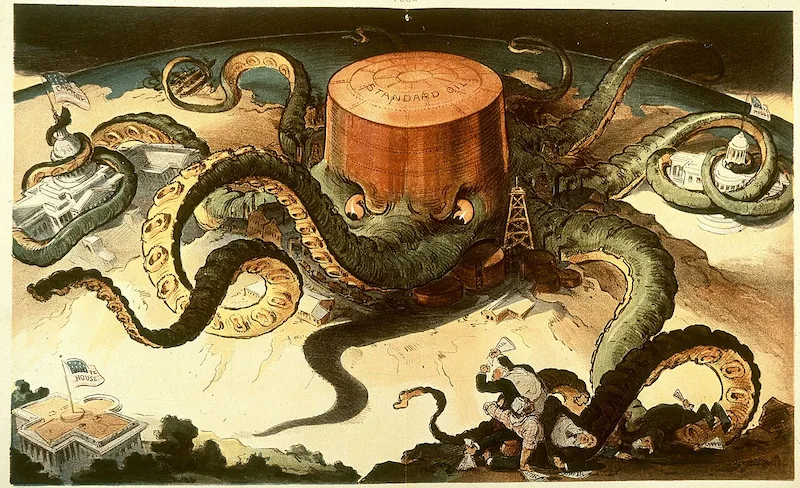
Although it was a period of extraordinary technological progress, delivering most of the major twentieth-century innovations, between 1895 and 1904, more than 2,000 firms were merged into 157 large trusts, leaving virtually every sector of the US economy dominated by a powerful monopolist. Those who created these trusts believed they were doing God’s work of strengthening the economy by saving it from “ruinous” competition.
For any democracy to have legitimacy, citizens must trust its institutions.
Supported by ideas of the eugenicist Francis Galton and Herbert Spencer’s social Darwinism, business leaders saw themselves as the superior, intelligent men who had prevailed in the process of natural selection. They believed they were building a new society in which a few strong men would lead with strong monopolies that would absorb small firms because they were weak. The big monopolies were thus considered progressive organizations. As John D. Rockefeller put it, monopolization was unstoppable because it was “the law of God.”
The false theory of eugenics was popular during the first Gilded Age because it offered the rich a “scientific” explanation for their superiority over those less well-off, thereby justifying their opulent lifestyles. Today, with knowledge of genetics, the wealthy cannot claim to be more intelligent than others, but many still feel superior and have found other ways to express it.
In “The Techno- Optimist Manifesto,” published in October 2023, venture capitalist Marc Andreessen envisages a future in which technologists create a “techno-capital machine” that produces all necessities at vanishing cost. In this telling, technologists lead humanity with their innovations and maintain social order. Their “enemies” are bad ideas such as social responsibility, risk management, and regulations. As an advocate of free-market capitalism, Andreessen sees little use for most government services and combines technologists’ leadership with free markets to allocate resources and determine values.
This vision, relatively common in Silicon Valley, is clearly antidemocratic. According to Andreessen, the world is converging toward a system ruled by technologists, and most people have no significant market value.
Declining Democracy
Given this background, the decline of democracy in industrial societies results from three factors: Policy, Culture, and Technology. I specify details for the United States, but analogous details apply to most advanced economies.
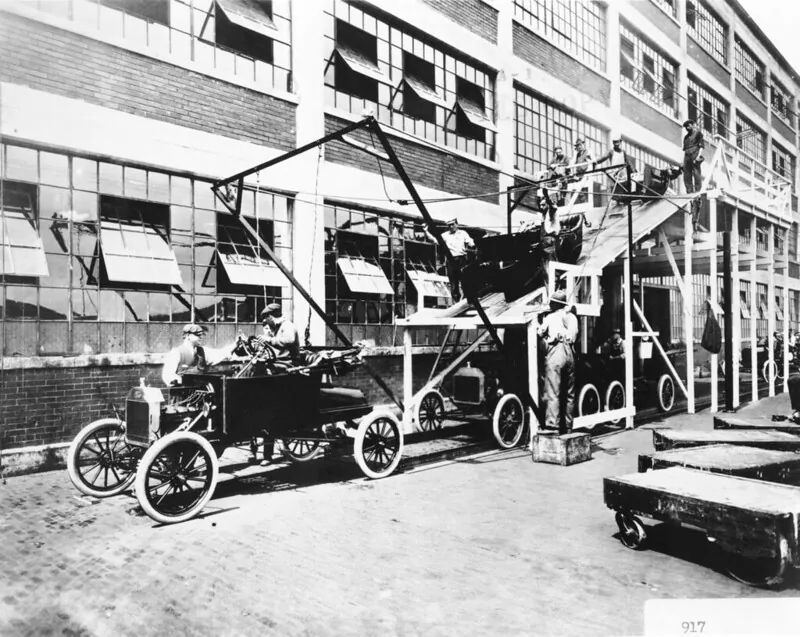
The combined consequences of the three factors were severe. Families faced devastation as incomes fell sharply, and drug addiction and suicide rates climbed. The economists Anne Case and Angus Deaton documented how they shortened the lifespans of white workers without college degrees. These three factors also accelerated the decline of domestic manufacturing, destroying blue-collar jobs and explaining why, since 1978, inflation-adjusted hourly wages of workers without college degrees remained roughly the same. All this took place while America ignored the vast damage to its workers.
Donald Trump’s 2016 election to the presidency, the rise of MAGA, and the erosion of American democracy are the culmination of these developments. To build a winning coalition, Trump drew on the accumulated grievances of America’s unskilled workers that now constitute the dominant group within the MAGA coalition. These workers either experienced job loss and feel betrayed by American democracy—or are younger workers without college degrees anxious about their prospects in the age of AI.
For any democracy to have legitimacy, citizens must trust its institutions. But policy and technology, as explained, produced economic inequality, which became political inequality, depriving ordinary people of agency. The extreme culture of meritocracy led educated Americans to overlook the suffering of millions whose livelihoods were being destroyed. It is no surprise, then, that workers, families, and people in their regions of residence have lost faith in democracy. As democracy’s institutions failed to serve the needs of ordinary people, demagogues like Trump have stepped into the breach.
The Needed Reform
To restore democracy’s legitimacy, reforms are essential. Politically, reforms should include removing money from politics, eliminating the Electoral College for presidential elections, and removing the president’s absolute immunity from prosecution while in office. Economic reform must rest on three principles:
- Containing market power: requires restructuring the patent system, placing limits on mergers and acquisitions, higher taxation of corporate monopoly profits, and higher top marginal personal income tax rates.
- More equal sharing of technology’s benefits: establishing guardrails on AI that favor innovations complementing human labor rather than replacing it; upskilling service jobs to increase their productivity and pay;
- Preservation of livelihood: a federal legal obligation to restore the earning capacity of any worker whose job is eliminated by a publicly supported act. It requires full financial support during retraining and help finding a new job. Policies along these lines have been successfully developed in Scandinavia, Germany, and Japan, and have helped stabilize democratic institutions in those countries.
Power-worshipping oligarchs dominated America in the first Gilded Age but were challenged in 1901 by reform-minded leaders. The reform era, starting with Theodore Roosevelt and ending with Franklin Roosevelt’s New Deal, introduced progressive institutions like income tax, the Federal Reserve, and New Deal policies, restoring democratic stability for a century. We can do it again.
Further Readings