
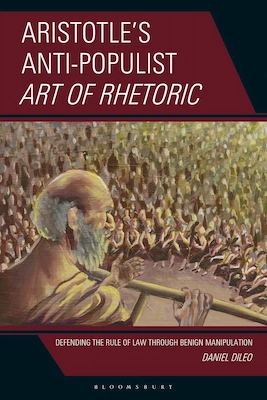
In Aristotle’s Anti Populist Art of Rhetoric: Defending the Rule of Law Through Benign Manipulation (Bloomsbury, 2026), I argue that populism shares essential features with what Aristotle called extreme democracy, and I examine his response to it.
- Extreme Democracy, Then and Now
- Aristotle’s Problematic Response to Extreme Democracy
- Some Problems with Aristotle’s Response
- Structure of My Argument: From “Activity in Accord with Virtue” to Regime Preservation
- From the Unreason of Dominant Factions to the Authority of the Political Art
- Aristotle’s Challenge to Our Time
- Implications and New Directions
There is no populism without a measure of democracy sufficient for a large portion of the population to empower someone in whom it sees itself embodied. With populism, that portion of the population conceives of itself as a homogeneous whole and considers its demagogue justified in overriding all constraints on its will.
My reading of Aristotle confronts them with the possibly anti-democratic assumptions that may lie beneath the surface of their aims and efforts.
All existing laws and norms that protect the rights and interests of minorities and support political restraint and the virtue of moderation on a personal level may be swept away by the will of the People, which understands itself as a righteous and homogeneous whole.
Extreme Democracy, Then and Now
What we experience as populism is strikingly similar in its key respects to what Aristotle perceived as extreme democracy. The latter was likewise lawless and immoderate. As with populism, authoritative decisions were arrived at without compromise and negotiation. Those decisions were products of the impulses of the demagogue and were implemented by his decrees. The constraints of tradition and established law were overridden.
In Aristotle’s view, extreme democracy and extreme oligarchy, likewise lawless, were similar in key respects to tyranny, and the last stop on the road to tyranny’s full-blown form (Politics 1292a4–23, 1313a39–b10).
Today’s populism differs from Aristotle’s conception of extreme democracy in that the object of the laws that it strives to override is the protection of the rights of minorities rather than education for the attainment of human flourishing.
But both variations are lawless. They work their will through violations of established laws and norms. I hold that then, as now, the aim of opponents of populism should be to preserve the authority of existing laws and norms. That was Aristotle’s aim.
If we accept that the aim of opponents of today’s populism should also be to preserve the laws and norms, we are led to look more closely into what Aristotle’s response to lawless democracy was and whether and to what extent his response is applicable today.
Aristotle’s Problematic Response to Extreme Democracy
His response is applicable to some extent but problematic, no less in our day than in his. His response had two parts. The first part was to equip his students to perceive threats to lawful rule and provide some strategies for averting those threats. He attempted to accomplish this through the teachings collected in his ethico-political treatises. Those teachings advocate regime preservation through inclusiveness and political moderation. That remains good advice.
Many scholars of the past generation have failed to see that Aristotle’s Politics and Nicomachean Ethics are elitist in spirit. Many of today’s readers of Aristotle recognize and appreciate proto-pluralist elements in his thought. But like the choir described by E. E. Schattschneider, Aristotle’s mixed and moderate regimes have “an upper-class accent.” They are therefore not democratic in the usual sense of the word.
Aristotle’s Anti-Populist Art of Rhetoric offers tentative criteria for the justified use of manipulative rhetoric.
Aristotle’s ethico-political teachings imply the need for an art by which the more prudent few might manipulate the less prudent majority. The aim was to obtain the assent of the many by pretending to share their aims and prejudices and by making arguments that were fallacious or unconvincing to the speaker, but convincing to the many. Such was the purpose of the teachings we find in The Rhetoric.
Its practical core consists of a set of manipulative techniques for persuading the citizenry. One of the major techniques was the use manipulative maxims. These were sayings that gained the trust of the many by echoing their unexamined assumptions but using them to gain assent to collective choices that supported moderation, inclusiveness and compliance with existing norms to a greater extent than the many might otherwise be inclined to favor.
Another rhetorical technique that Aristotle taught was the use of metaphors designed to make speech vivid by placing it “before the eyes” of the intended audience and steering its attention away from subjects that would conduce to lawlessness and extremism. The third was the employment of “topics,” brief pieces of reasoning, often fallacious, that were familiar to the many, but used in the service of moderation, inclusiveness, lawfulness, and the virtues taught by existing laws and norms.
Some Problems with Aristotle’s Response
Although he was not as attuned as we are to the problem inherent in the rule by elites by means of manipulative rhetoric, Aristotle did recognize one problematic aspect of it. He saw the possibility that the elites might use their ability to manipulate the many for the purpose of enriching themselves or gathering honor to themselves. He took measures against those possibilities by disparaging the desire for wealth and through a radically countercultural devaluation of honor and the love of honor.
It was a fundamental tenet of Aristotle’s political art that regimes were preserved through political moderation and inclusiveness.
But he left us without advice for addressing another, more profound, aspect of the problem, the undermining of the very regime that manipulative rhetoric is intended to protect. For, as he knew, a regime of lawful rule is formed and sustained by transparent communication among the citizens about what is just and mutually beneficial (Politics 1253a7–18).
Lawful rule is therefore undermined, at least over the long term, by manipulative rhetoric, no matter how benign its intent of opposing collective choices that threaten the rule of law in the short term. Aristotle’s Anti-Populist Art of Rhetoric offers tentative criteria for the justified use of manipulative rhetoric. I offer Martin Luther King’s “Letter from a Birmingham Jail as anexample of quite possibly manipulative rhetoric that meets one of those criteria, correction of a severe and pervasive deviation from what is right by nature. I also offersome examples of manipulative rhetoric that do not meet them.
Structure of My Argument: From “Activity in Accord with Virtue” to Regime Preservation
The argument of this book proceeds by establishing the following series of six links, connecting the human good at one end to manipulative rhetoric at the other.
The first link connects the human good (eudaimonia) to “activity in accord with virtue” (NE 1098a16–17). The second link connects such activity to habits instilled under the guidance and force of the laws (NE 1129b14–27, 1103b23–4, 1103a17). The third link in the chain is Aristotle’s claim that the effectiveness of systems of laws in the formation of habits and character depends on their persistence over time (Politics 1269a5–25).
The fourth link is Aristotle’s assertion that the preservation of regimes is the penultimate purpose or end of the political art (1319b33–1320a4). A fundamental premise of that art is that the greatest internal threat to the preservation of existing regimes is political extremism, which results initially in lawlessness (1292a4–7) and ultimately something akin to tyranny (1292a15–23, 1313b32–3), which is marked by implacable hostility to every form of human flourishing (1313a40–b32).
The practical core of the political art is a general outline of measures featuring inclusiveness and moderation for the purpose of preserving existing systems of lawful rule (1308a3–8, 1309a13–17, 20–3, 27–32).
From the Unreason of Dominant Factions to the Authority of the Political Art
Aristotle’s assertion that the dominant factions of the prevailing regimes of his day, the many and the rich, were resistant to reasoned argument (1296a22–7, 1295b6–9) is the fifth link connecting rhetorical manipulation to the attainment of the human good. If those factions were to be persuaded to turn away from indulging their extremist inclinations (1310a2–12), they had to be persuaded by means other than or in addition to reasoned argument.
These other means include manipulative rhetoric. Of course, it is possible, perhaps likely, that the prudence and judgment of the wealthy and the many were greater than he thought and that there was no need in the cities that he knew for manipulative rhetoric for the sake of regime preservation.
Populism of our time will not end with the passing from the scene of the populist leaders of the moment. Its immediate causes include the erosion of cultural and legal constraints on popular as well as elite behavior.
But if we are to benefit from the challenge with which Aristotle confronts us, we must understand the problems of politics as he perceived them. We must see what Aristotle thought of the cognitive and ethical competence of the dominant factions, particularly the faction of the many, because that bears directly on his conception of rhetoric. More specifically, it bears on the question of whether he believed that the many would respond to transparent, well-informed, logical argument.
The sixth and final link in the chain connecting human flourishing to manipulative rhetoric is Aristotle’s subordination of his art of rhetoric to his political art (NE 1094a26–b7). That subordination entails the employment of the art of rhetoric for the attainment of the end of the political art. That end was the human good by means of stable, and therefore effective, systems of laws and norms (NE 1129b14–27, Politics 1269a5–25). As noted above, it was a fundamental tenet of Aristotle’s political art that regimes were preserved through political moderation and inclusiveness. A regime that had no enemies within was vulnerable only to external threats and able to unify in resistance to them.
Aristotle’s Challenge to Our Time
Populism of our time will not end with the passing from the scene of the populist leaders of the moment. Its immediate causes include the erosion of cultural and legal constraints on popular as well as elite behavior. Underlying factors include economic and status inequality and insecurity and the extreme democratization of sources of political information (and misinformation). All of these can and should be reduced to the extent possible. But they are here to stay for the foreseeable future
In the near term, those who intend to defend the laws that protect minorities against resentful majorities and the demagogues who embody their resentments must find an elusive and shifting mean between the two poles of effective rhetoric on the one hand and respect for the autonomy of those whom it aims to persuade on the other.

Implications and New Directions
The subdiscipline of philosophical ethics has recently seen new challenges to Kantian and post-Kantian ethics. But has not yet extended that challenge to questions of political ethics. This reading of Aristotle ethico-political treatises and Art of Rhetoric challenges philosophers of ethics to do so.
For obvious reasons, interest in populism among political scientists has skyrocketed in recent years. The efficacy and dangers of the range of practical responses to it need to be more fully explored. Some of those resisting directly and significantly in the political arena are presently engaging in manipulative means of persuasion.
My reading of Aristotle confronts them with the possibly anti-democratic assumptions that may lie beneath the surface of their aims and efforts. By doing so, it may cause them to be more prudently sparing and judicious in their employment of anti-populist manipulation.