More than any other regime, democracies rely on the power of public speech or what used to be known as the art of rhetoric. Democratic governments have rightly been called “logo-centric” or talk-centered because most of what goes on, whether on the floor of Congress, in town hall meetings, or in the jury room, takes place in and through language. Drawing on an idealized image of ancient Athens, John Stuart Mill once described democracy as government by discussion.
The American polity has become a rhetorical democracy, that is, increasingly dependent on the power of speech. Ever since Theodore Roosevelt and Woodrow Wilson, the office of the presidency has increasingly become a vehicle for the mobilization of mass opinion. What was once regarded as a limited constitutional office has now become a kind of plebiscitary office with a direct line of communication between the president and the people. From Reagan to Clinton to Obama and Trump, we expect the president to be a “great communicator” — or tweeter — and we think less of presidents who are not.
The ability to distinguish between persuasive speech and demagoguery remains one of the most pressing tasks of modern democracies.
In my recent book On Statesmanship, I argue that rhetoric remains an indispensable part of the statesman’s toolkit. Given its authoritative expression in the Art of Rhetoric, Aristotle distinguished three features of persuasive speech that he called logos, ethos, and pathos. We can call this Aristotle’s triangle. Let me consider each of these in turn.
Politics as Truth-Telling
The first feature of persuasion is logos, a term that conveys reason or rationality but which I prefer to think of as a capacity for truth-telling. Politics is about the giving and sharing of arguments over questions of justice, the common good, and who should rule.

The polity is a rational whole in the sense that it presupposes a world of common facts and experience from which statesmen and citizens can draw their arsenal of arguments.
This is a distant ancestor of what contemporary philosophers like John Rawls and Jürgen Habermas have called “public rationality,” suggesting that only what appeals to publicly verifiable evidence can count as reasons in the forum of political deliberation.
The statesman’s first responsibility consists in the capacity for truth-telling or adherence to the canons of what Jonathan Rauch has called “the reality-based community.” This forms the basis of a shared world of facts in which political debate and decision-making can take place.
To be sure, there will always be disagreement about the meaning of the facts, but without some basic consensus on what the facts are, political life will devolve into a Hobbesian state of nature in which every person is simply entitled to their own truth. It is precisely this kind of epistemic anarchy that is sown today by conspiracy theorists, internet trolls, and other purveyors of disinformation.
Politics and Trust
What makes an argument convincing? It is not reason and logic alone but the character of the speaker. Political arguments are not carried out in a laboratory or a seminar room where they might be judged by the force of the better argument. Political arguments are ad hominem in nature. They are performances addressed by a particular speaker to a particular audience under particular circumstances. Who is making the argument will in part determine its success.
The power of narrative is both necessary and dangerous.
This is where ethos enters the picture. Ethos is a term that is often translated as character or habit but which I think of as a form of public trust. There must be a certain level of trust between a speaker and an audience, and this can only be assured when the character of the speaker exhibits qualities that an audience finds worthy of esteem. This capacity to establish trust is a matter of ethos or character.
Trust is not intended simply as a supplement to reason-giving but is a precondition for it. We speak of taking arguments “on faith” largely because we have a prior inclination to believe what a speaker is saying. Why? Presumably because the speaker must possess certain character traits that we find admirable, which may include courage, practical wisdom, a reputation for success, a willingness to challenge dogmas, or even such things as a fiery temperament or a capacity for indignation. Any or all of these may provide an incentive to believe what they say.
Politics and Narrative
The final quality needed for effective speech is pathos, a word translated as passion or emotion. It is not enough for the statesman to present rational arguments and to be of good moral character; it is necessary to touch people’s hearts, to persuade them that she not only thinks but feels as they do. It is important to engage a people’s moral sympathies. Pathos is distinctly theatrical in tone. It is necessary to establish a degree of empathy between leaders and the public.
The art of rhetoric was once considered the core of all humanistic studies.
The idea that politics is a matter of affective behavior has always been understood by great political leaders who know how to connect with their audiences. This is why they speak not only in terms of reasons and arguments but in narratives and stories that connect a people to their history, traditions, and collective memories.
We are not only rational animals but storytelling beings who view ourselves through the narratives and mythologies that we create to make sense of our experience. When Lincoln appealed to “the mystic chords of memory,” or when John Kennedy said “ask not,” or when Ronald Reagan referenced the “shining city on a hill,” they were invoking images that could serve to connect people to their highest aspirations.
The difficulty comes when we attempt to translate reason-giving into narrative forms. Argument is one thing; storytelling another. Stories may have an immediate “feel good” effect, but overdone, they can have a corrosive influence on truth. Emotionally charged stories can provide a temporary moral high for an audience but can end up increasing feelings of anger and frustration. Stories are intended to illustrate arguments, not to replace them. Inevitably, the process of translation involves a simplification and therefore a distortion of the truth.
It is easy for stories to become unmoored from fact and evidence and take on a life of their own. Conspiracy theories are one form of storytelling. It is enough to claim “a lot of people are saying” to make something seem true. This arises from the very human need to turn apparently random acts into a plan or a pattern. It is the feature of the conspiratorial mind to be able to prove that all events, however seemingly random or contingent, form part of the same design manipulated, generally, by a single malign force.
The power of narrative is both necessary and dangerous. Some narratives, like the American Dream may speak to a people’s highest ideals, while others, like the myth of the master race or the myth of the classless society are apocalyptic doctrines that have morphed into spectacles of terror and violence. It is important that a statesman be able to invoke the power of narrative, but this must always be guided by an ethic of restraint, responsibility, and a concern for truth.

Conclusion
The art of rhetoric was once considered the core of all humanistic studies. In the ancient world, rhetoric was considered a necessary component for participation in political life. Today, rhetoric is too often regarded as “hot air” or a cynical mask for the speaker’s hidden motives and ambitions. But this is to simplify. The ability to distinguish between persuasive speech and demagoguery remains one of the most pressing tasks of modern democracies.
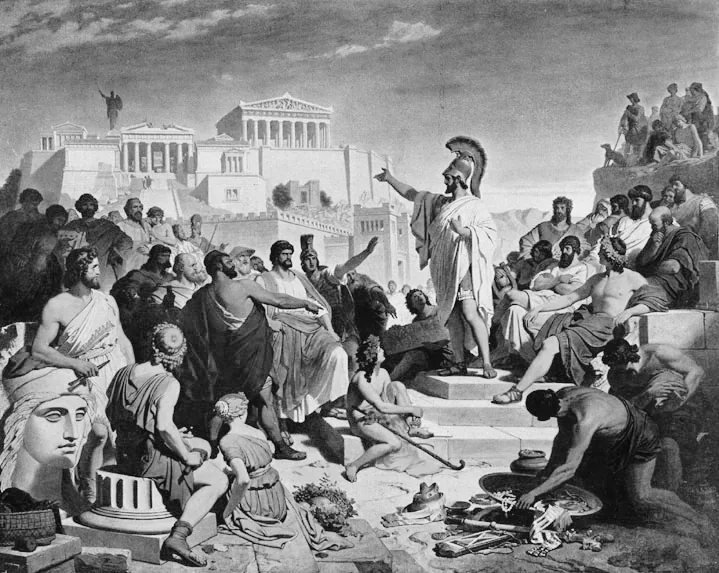
The greatest statesmen — Pericles, Lincoln, Churchill — have all been masters of persuasion. They were able to set a course for their countries through powerful narratives and symbols and communicate it to others through rational speech and images. To master the art of public speaking was and remains a requirement for effective citizenship. The neglect of this art is in part responsible for the degradation of our contemporary public culture.
Further Readings