When Fear Is No Longer Enough
For more than six decades, the Cuban regime has survived profound economic crises, the disappearance of strategic allies, and—more recently—systematic waves of mass protests driven by social discontent.
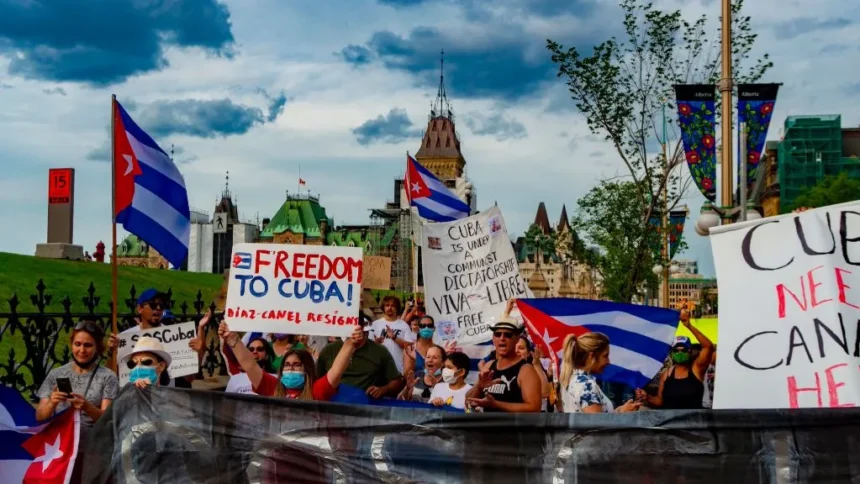
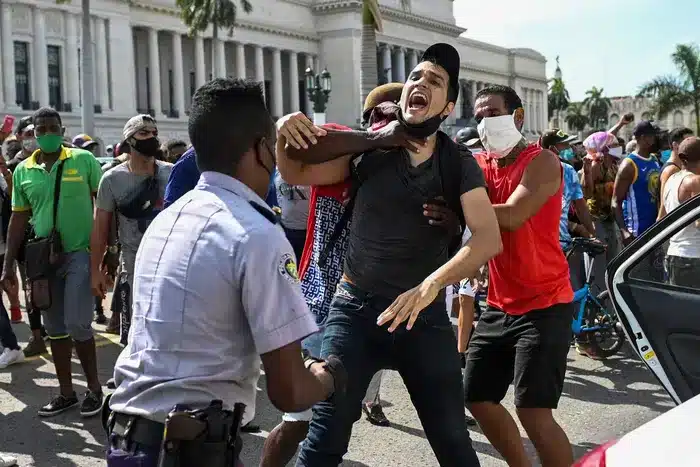
Perhaps the most critical moment for the regime’s survival, if we set aside the collapse of the socialist bloc, occurred on July 11, 2021, when mass protests erupted simultaneously across the country, calling for the end of the dictatorship and shattering the international fiction of majority popular support. The government’s response was immediate: large-scale arbitrary detentions, the use of police and paramilitary forces against peaceful demonstrators, summary trials without due process, information censorship, and intensified social control.
For the first time in years, the Cuban regime’s main external support ceased to be a guarantee and became a vulnerability.
Despite the fear generated among the population by prison sentences of up to 25 years for participating in the protests, July 11 marked a turning point. Forced exiles, legislative changes to tighten restrictions on freedom of expression, the forced confinement of journalists to their homes, exemplary punishments, expulsions from workplaces, open threats to the security of dissidents and their families, street patrols with dogs, and the impunity with which police forces operate have not been enough to halt protests.
In fact, 2025 closed with 11,268 incidents of protest and citizen complaints—more than 25% above the 8,443 recorded in 2024—according to the Cuban Observatory of Human Rights, while Prisoners Defenders reported 134 new political prisoners, bringing the total to 1,197 by year’s end.
If the government has been relatively successful in its social control through repression, its opponent until now has been an exhausted, impoverished, and unarmed population. The current context, however, is radically different.
The Collapse of Venezuelan Oil Supply and the Fragility of Mexican Support
The removal of dictator Nicolás Maduro and the subsequent subordination of the Venezuelan government to Washington’s dictates severely weakened Venezuela’s capacity to sustain its main ally, the Cuban communist regime.
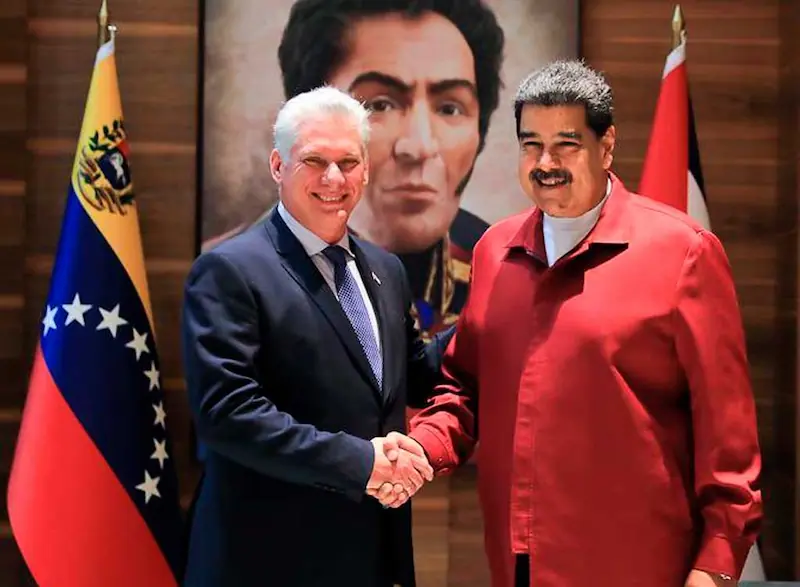
For Cuba, the effect was immediate: less oil, a smaller margin for maneuver, and growing external pressure at the worst moment of its internal crisis. For nearly two decades, the Cuban regime maintained minimal stability thanks to a steady flow of subsidized oil from Venezuela. That support made it possible to offset the structural inefficiency of the Cuban economic model and avoid a total energy collapse, while also profiting from the resale of much of that oil.
The removal of Nicolás Maduro and the reconfiguration of the regional balance marked a turning point.
Between late 2024 and late 2025 alone, the Cuban government re-exported close to 60% of the oil it received from Venezuela, sending approximately 40,000 of the 70,000 barrels per day received to Asian markets for commercial resale, while millions of Cubans faced prolonged blackouts and chronic fuel shortages amid the island’s full-blown energy collapse.
Mexico, which had temporarily emerged as a key energy supplier, is now constrained in a context in which the United States threatens commercial sanctions and tariffs against anyone who sells oil to Cuba. The Donald Trump administration has abandoned any logic of détente and has openly opted to force Havana to negotiate from a position of extreme weakness.
The message is explicit: without substantive political concessions, there will be no economic relief or easing of sanctions.
Without a stable supplier willing to bear the costs of its survival, the Cuban regime faces an unprecedented dilemma: undertake deep reform of a system resistant to change or manage a continuous deterioration that can no longer be concealed behind ideological discourse.
Forced Recruitment as a State Response
Beyond rhetoric oscillating between patriotic slogans and an illusory openness to negotiations “without pressure,” the state’s response has consisted of strengthening control and surveillance over opponents and forcibly mobilizing young people for Military Service, without clear information or guarantees.
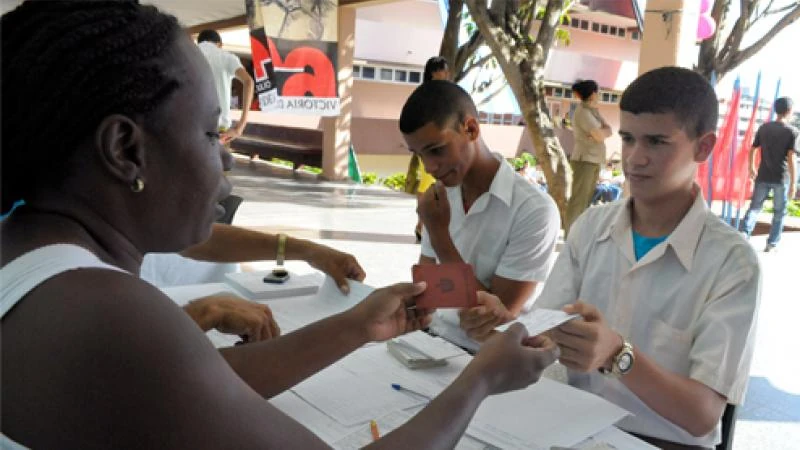
This has, unsurprisingly, generated social alarm and public denunciations by activists and dissidents. A few days ago, a young Cuban said during a live broadcast that he was afraid and did not want to be part of this recruitment, holding the government responsible for whatever might happen to him, including a possible enforced disappearance.
The government presents this strategy as a patriotic duty, but in everyday experience it is felt as coercion, especially among families who fear for their children’s safety. The regime is forcing sectors of the population to actively defend the very system that oppresses them.
This climate has been worsened by deaths and accidents during military exercises with live weapons, followed by institutional opacity and a lack of convincing explanations.
Repression, Prison, and Torture: The Cost of Taking to the Streets
On social media and in exile, part of the opposition discourse shifted from requesting humanitarian aid to openly calling for an “intervention.” Inside the island, where expressing that idea can entail imprisonment, real support is far harder to measure; but the mere emergence of this stance and its public circulation reveal a rupture: for many, change ceased to be imagined as an internal reform and began to be conceived as an outcome imposed from outside. “It’s the first time I really have hope,” one of the few friends who has not yet managed to escape the regime told me recently.
If a few years ago a military intervention would have been perceived as unthinkable, today many Cubans see it as a necessary option. This is not about wanting to surrender the country’s sovereignty, but about deep desperation in the face of the absence of any internal path to transform the system.
The wounds of the brutal repression of four years ago are still present. If punishments were exemplary then, many fear they could be far worse in a context of intervention by the regime’s historic enemy. They know that repression in Cuba is neither reactive nor improvised: it functions as a structural state policy aimed at deterring dissent before it spreads. They fear prison, but know it is even worse when imposed for political or ideological reasons.
A comprehensive study by Prisoners Defenders, based on a representative sample of political prisoners extrapolable to more than 1,200 people deprived of liberty for political reasons, shows a central fact: political imprisonment in Cuba systematically entails cruel, inhuman, and degrading treatment.
The regime is forcing sectors of the population to actively defend the very system that oppresses them.
Put differently, torture in Cuba for political reasons is neither sporadic nor isolated. Incommunicado detention with family members and lawyers, the deliberate denial of medical care, prolonged solitary confinement, physical assaults, and constant humiliation are part of the same apparatus: an ordinary administrative technique, applied with simple means and total impunity.
This systematic character serves a precise function. Prison operates not only as punishment after protest, but as a preventive mechanism of social control. In a country marked by prolonged blackouts, scarcity, and collective exhaustion, the message is clear: it is preferable to remain hungry at home than to be tortured in the state’s prisons.
Conclusion: The Cuban Dictatorship at an Unknown Threshold
It is not possible to anticipate what will happen in the coming days. What can be stated is that Cuba no longer operates within the parameters that for decades allowed the regime to manage internal crises as strictly domestic matters. The combination of energy collapse, persistent protests, and the loss of external support has shifted the Cuban problem into a broader sphere, where decisions made outside the island weigh as heavily as those taken in Havana.
The removal of Nicolás Maduro and the reconfiguration of the regional balance marked a turning point. For the first time in years, the Cuban regime’s main external support ceased to be a guarantee and became a vulnerability. In this context, intervention no longer appears merely as a marginal slogan or rhetorical threat, but as a strategic possibility that forms part of the calculations of external actors and of the Cuban government’s own official discourse.
The scenario remains open, and its evolution will depend on an unstable combination of international pressure, political decisions, and regime responses. The only certainty is that the Cuban case has ceased to be a frozen dossier: it has become an active problem of the regional order, whose development can no longer be read exclusively through an internal lens. At minimum, the U.S. government now asserts that channels of dialogue exist and that Cuban authorities are engaging, however cautiously, in ongoing talks.