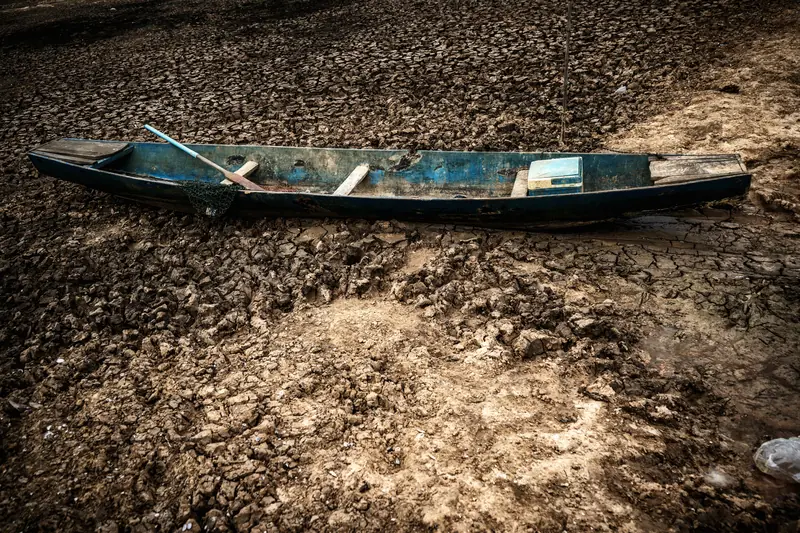
Societies globally face imminent catastrophe. Scientists’ warnings have been ignored. A mad king says it is all a hoax, as if the power of his words can turn the tide. This sounds like science fiction, but it is the world we are living in now.
Climate change impacts societies differently. We are not all equally vulnerable. In the Global North countries of North America and Europe, well-developed infrastructure and stable economies provide more separation and safety from ecosystem changes than in the Global South, at least for now. Those economies and infrastructures were built upon the wealth extracted through colonialism, powered by industrialism, dependent on fossil fuels. The burning of those fuels created the atmospheric imbalance scientists name as global climate change. It is the outcome of inequitable systems of extraction and dispossession.
Professional climate skeptics work in think tanks, PR agencies, and political parties arguing that any observed climate changes are part of natural variation.
A Perturbed System: Religion and Climate Change from the End of a World describes the responses of people in the US and Northern Europe to this slow burning, ongoing catastrophe that high-income groups in their societies are most responsible for, yet are least impacted by. Some deny it, cheering on carbon-intensive business-as-usual. Some foresee doom, but are paralyzed by it. And some are weeping, mourning biodiversity loss and mass extinction.
I trace their stories collected through in-person interviews, observations of events such as protests and retreats, social media posts, even fragments of graffiti. This is climate change discourse. A Perturbed System offers two main contributions to the social scientific study of climate change. The first is an academic argument about the significant yet overlooked role of religion in shaping climate change discourse. The second has wider appeal, offering an examination of how people are living in a time of endings.
What Does Religion Have to Do With Climate Change?
The first thing to clarify is what I mean by religion. Religion, here, does not refer to the activities and ideas of self-identified religious people. This is not a book about what Christians think about climate change. It is a book about the cultural influence of religion, a pervasive effect that lingers through history affecting those who would not call themselves religious as well as those who would.
It is about those continuing conceptual inheritances bequeathed by the long history of Christianity in the US and Northern Europe. Protestantism emerged alongside colonialism and industrialism, and the ecological result was climate change. This is the important yet overlooked influence of religion on climate change discourse.
Nature is one such concept that continues to take its shape from Christian influences. The Christian histories of Europe and North America contribute to thinking of nature as something separate from humans and culture that can be used instrumentally and extractively.
In the biblical Book of Genesis, God granted humans dominion over nature, which has been interpreted especially in Protestant traditions as allowing the use of nature as a resource to supply human needs. This way of thinking set up the Earth, and its minerals, as available for rapacious extraction and combustion, the emissions from which drive what scientists now call anthropogenic climate change.
The rejection of consequences from this process can also be traced back to Protestant values. Separated from nature, humans have a specific cosmological place in Christian theologies. The world is ours to use, but we are not ultimately in control of what happens to it. Only God can truly affect nature; humans do not have that power. To think otherwise is hubris. And only God knows when the world will end, with the return of Jesus Christ.
Faced with the reality of ongoing ecological crises, some still deny the cause.
These ideas limit climate discourse in contradictory ways. On the one hand, conservative Christians in the US see the premises of climate change science as almost blasphemous, thinking they can predict what will happen to nature using computational models as opposed to trusting God and receiving his blessings in the form of coal, oil, and gas. On the other hand, for ecologically concerned people in Europe and the US, climate change becomes feared as apocalyptic.
The theological motif of apocalypse runs deep through climate change discourse. Even as the IPCC walks back from worst-case scenarios, fears of ecosystems passing tipping points and societal collapse take the form of a looming apocalypse. A Perturbed System traces howtheological motifs, such as apocalypse, drawn from Protestant Christianity continue to operate in the present climate changed world as concepts and values with continuing cultural influence.
Living in A Time of Death
Thanatocene means the era of death. The term was coined by historians Jean-Baptiste Fressoz and Christophe Bonneuil as a critique of the term Anthropocene, which was itself developed to periodize the impact of humans on the geological strata of the earth. Human activity can be read in the soils irradiated by nuclear material, in the oceans infiltrated by microplastics, and in the rising levels of carbon dioxide in the atmosphere from burning fossil fuels.
Some scholars proposed the end of the Holocene, and the beginning of the Anthropocene, as a new geological era. For Fressoz and Bonneuil, this concealed the real impacts of a small group of humans not only on nature but also on the rest of humanity through industrial-military fallout and intensive resource extraction, the effect of which was, largely, increased death. I heard the term Thanatocene first from an activist at a week-long course in Sweden, who was describing the olive trees on his property in central Italy that died en masse during a heatwave.
Such unprecedented impacts continue to create new precedents. As I visited England for fieldwork in 2019, scientists at the Cambridge University Botanic Garden recorded a new highest temperature for the country of 38.7 °C. That record was broken only three years later in July 2022 when the temperature reached 40.3 °C. In 2026, England experienced prolonged drought and two periods of heatwave in May and June, before summer had even begun. The green fields turned yellow, auguring that dangerous climate change had arrived.
The more success, the more wealth, the more you contribute to the problem.
During my fieldwork in 2018 to 2019, activists mobilized to force government action to stop or slow these changes.
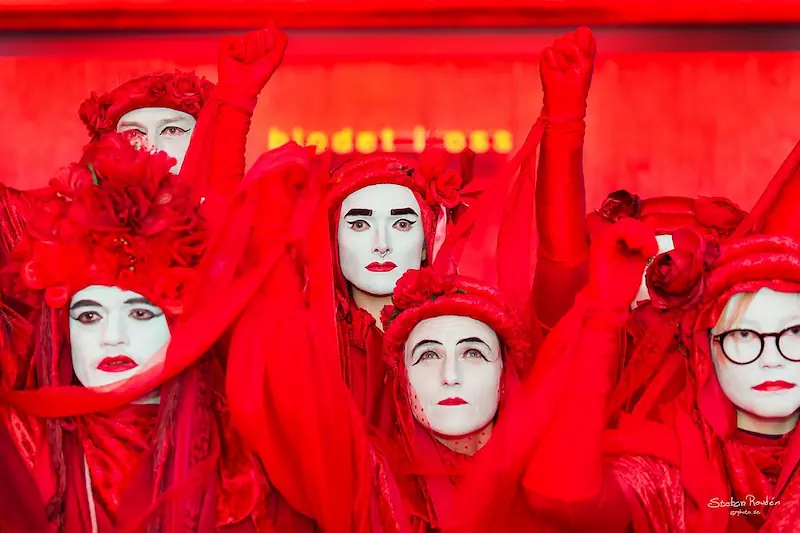
Extinction Rebellion occupied roads, bridges, and squares in London and other cities, using civil disobedience to drive climate change up the agenda and get the government to take more action.
Starting in Sweden, across Europe school children skipped school one day a week to protest that more was not being done to stop climate change. They asked how they could learn if they had no future.
Climate change perturbs ecological systems, disrupting the predictability that complex human societies have grown dependent on to function. Transportation systems break down as floods and fires interrupt routes. Supply chains lengthen and weaken as routes for global trade close. As children and young people lose faith in their futures, education systems start to falter. In political systems, politicians do not offer solutions to real problems, instead holding up scapegoats to distract from their failures. Citizens withdraw into cynicism, and in the vacuum mad kings take power. Systems are failing; things are falling apart.
Deny, Delay, Despair
Faced with the reality of ongoing ecological crises, some still deny the cause. Professional climate skeptics work in think tanks, PR agencies, and political parties arguing that any observed climate changes are part of natural variation. Fossil fuel companies continue to fund disinformation while receiving trillions in government subsidies globally. The injunction by some politicians to “drill, baby, drill” may not be a rallying call so much as a description of observed reality.

Against this backdrop, delay has become the new denial. Not denying that climate change is happening, but delaying doing anything effective to mitigate it or adapt to it. The lack of effective action leads some into despair. They have their own spokespeople, who foretell doom in the form of imminent societal collapse or even near-term human extinction. Despair has the same effect as denial and delay; we do nothing.
Doing something, I found through the course of my research, was not straightforward. I met engaged activists who burned out through joining environmental movements using civil disobedience that achieved limited media recognition and increased police repression. Wanting to do something did not mean something effective could be done. Even going to courses and retreats to meet and organize with other activists increased their carbon footprints. Every step taken in fossil capitalism burned more carbon.
Thinking climate change is the apocalypse may be a religious response, but that does not make it any less catastrophic. But the end of this world is not the end of all worlds. Worlds have ended before. For those who contribute most to climate change through living and working in high-carbon societies of the Global North, I found that what we can do is rest.
Walk away from ideas of success that result in living more carbon-intensive lives through frequent flying and luxury purchases. Success leads to a high-carbon lifestyle. The more success, the more wealth, the more you contribute to the problem. The only ethical way to be successful in this time is to undo and step away from the thing that made you successful, and to live slowly, quietly, compassionately. We need to rest.