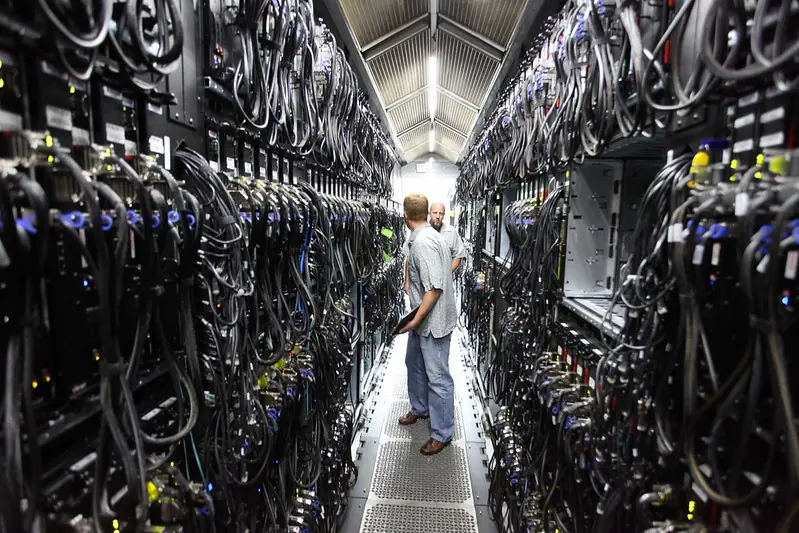
Public resistance to artificial intelligence, what is now widely called the AI backlash, is no longer confined to debates about regulation among specialists. Across the United States, a coalition that cuts across the ideological spectrum is mobilizing against the physical infrastructure the technology depends on: the data centers that consume electricity, water, and land at a scale few communities anticipated.
On a single day in July 2026, organizers held 142 protests against data centers in 42 states. In the first three months of the year alone, local opposition had already blocked or delayed 75 projects worth more than $130 billion. What began as scattered local disputes over noise, water use, and rezoning has become a structural feature of American politics heading into the 2026 midterms.
What ties these episodes together is not a shared organization or platform but a common grievance: that AI’s physical footprint is expanding faster than the public consent for it. That grievance is what the AI backlash actually names, and it is worth tracing from its origin.
The Rise of the AI Backlash
The AI backlash is notable for its composition. Community groups worried about energy and water consumption, artists and professionals concerned about job displacement, and civil rights advocates focused on surveillance have found themselves in the same rooms as conservative activists suspicious of concentrated corporate power. Brookings researchers describe this less as a coherent ideology than as a fight over whether AI’s infrastructure will answer to democratic institutions or to the companies that control it.
Polling confirms the sentiment reaches well beyond the activists at the microphone. In a Pew Research Center survey conducted in June 2026, 52 percent of American adults said they were more concerned than excited about AI’s growing role in daily life, against just 9 percent who felt the opposite, a gap that has widened sharply since 2021. Seventy-one percent now expect AI to reduce the number of jobs available over the next two decades. The unease is no longer confined to older Americans: for the first time, a majority of adults under 30 report the same concern.
The pressure has reached the companies themselves. As Anthropic and OpenAI approach IPOs that could value each near a trillion dollars, public distrust is expected to appear as a named risk factor in Anthropic’s prospectus. Anthropic CEO Dario Amodei acknowledged as much in a public post, writing that “it is fundamentally a crisis of trust” between the industry and the public it depends on.
AI Backlash and Democratic Legitimacy
The deeper issue is one of accountability. State legislatures have not been passive: by March 2026, lawmakers in 45 states had introduced 1,561 AI-related bills, already surpassing the total for all of 2024, on top of the 1,208 bills introduced in 2025. Enactment rates remain modest, but the volume signals that state legislatures see AI governance as unfinished business.

That activity has now collided with a countervailing federal push in the opposite direction. In December 2025, the Trump administration issued Executive Order 14365, which directs the Department of Justice to stand up an AI Litigation Task Force whose sole responsibility is to challenge state AI laws on constitutional and preemption grounds, and which threatens to withhold federal broadband funding from states that decline to fall in line.
Legal analysts are divided on whether an executive order can accomplish this without congressional legislation, but the intent is unambiguous: to override, through federal litigation and funding leverage, exactly the kind of state-level lawmaking the AI backlash has helped generate. An abstract concern about unaccountable governance has become a live legal and political conflict between two levels of government, each claiming a different democratic mandate.
From Technology Policy to Electoral Politics
Nowhere is the translation of this conflict into electoral terms clearer than in Virginia’s 2025 gubernatorial race. Democrat Abigail Spanberger built part of her winning campaign around a pledge to make data centers “pay their fair share” of the energy costs they impose on other ratepayers, while outgoing Republican Governor Glenn Youngkin favored continued expansion paired with on-site power generation. The fight was concrete rather than symbolic: state lawmakers seriously considered ending early a data center tax exemption that saved the industry $1.9 billion in a single year, a dispute serious enough to threaten a state government shutdown.
Virginia is not an isolated case. In Georgia, Democrats flipped two Public Service Commission seats in 2025 by more than 25 points campaigning chiefly on rising utility costs tied to data center demand. Governors who had courted the industry with tax breaks, including Pennsylvania’s Josh Shapiro, Illinois’s J.B. Pritzker, and Maryland’s Wes Moore, have since proposed moratoriums on incentives and new environmental conditions as electricity bills became a voter issue.
Heading into 2026, the pattern has spread into open Senate and gubernatorial races: in Michigan, one Senate candidate has demanded binding community protections before new projects proceed while a gubernatorial candidate has called for a construction moratorium, and a Wisconsin state legislator is running for governor on a statewide pause.
This sequence, local grievance over cost and land use turning into a defined electoral position within a single cycle, resembles how earlier economic shifts became partisan fault lines only once they were tied to visible household costs: fuel prices during the energy crises of the 1970s, plant closures during the trade shocks of the 1990s and 2000s. The AI backlash appears to be following the same compressed timeline, but faster.
A New Axis of Political Conflict?
If the pattern holds, AI governance may become one of the organizing conflicts of the coming electoral cycle, cutting across the traditional market-versus-state divide. One position, still dominant within the federal executive branch, treats state-level restriction as an obstacle to competitiveness and innovation leadership. The other, gaining ground in statehouses and now in governors’ mansions, treats unchecked buildout as a cost imposed on the public without its consent.
It is worth being honest about the limits of this framing. Opposition to a specific data center down the road is not the same as a coherent ideological position on how AI should be governed, and the coalition backing restriction includes people who want AI slowed for incompatible reasons: some out of concern for labor and privacy, others out of hostility toward the companies and elites building it.
Whether this AI backlash congeals into a durable axis of party competition, as trade and globalization eventually did, or fades once electricity prices stabilize and grid investment catches up with demand, is not yet settled. What is already clear is that the industry itself, not just its critics, now treats the loss of public trust as a material problem.
Further Reading
On the material costs behind AI’s infrastructure, Kate Crawford’s Atlas of AI: Power, Politics, and the Planetary Costs of Artificial Intelligence traces the mining, energy, and labor that data centers and AI models depend on, arguing that AI is best understood as an extractive industry rather than an immaterial one.
On the erosion of democratic oversight of technology companies, Marietje Schaake’s The Tech Coup: How to Save Democracy from Silicon Valley draws on her experience in the European Parliament to document how large technology firms have absorbed functions once reserved for elected government.
On the corporate logic driving the data extraction underlying AI systems, Shoshana Zuboff’s The Age of Surveillance Capitalism: The Fight for a Human Future at the New Frontier of Power remains the most widely cited account of how personal data became a raw material for prediction and behavioral influence.
On the electrical grid now at the center of the data center conflict, Gretchen Bakke’s The Grid: The Fraying Wires Between Americans and Our Energy Future explains why an aging, balkanized power system is so ill suited to absorb sudden new demand, a constraint now driving much of the political conflict described above.
Further Readings