Russia’s war against Ukraine has entered its third year, but the political transformation inside Europe may prove even more enduring than the battlefield dynamics. In recent months, European governments have accelerated defense spending commitments, expanded joint procurement schemes, and revisited fiscal rules to accommodate military investment. The strategic question is no longer whether Europe will rearm. It is whether the continent is drifting toward a permanent war economy.
The Return of the European War Economy
The concept of a war economy traditionally implies the large-scale reallocation of public resources toward defense production, industrial policy aligned with military needs, and political prioritization of security over welfare expansion. Historically associated with total war, the term is now resurfacing in debates across the European Union.
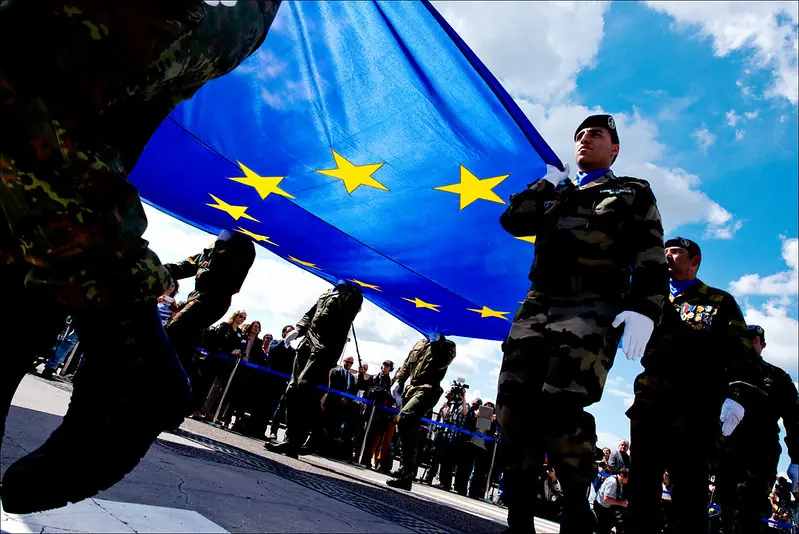
Recent initiatives include expanded joint weapons procurement, long-term ammunition production contracts, and discussions of common defense bonds. Simultaneously, fiscal frameworks have become more flexible. The reform of EU budget rules allows greater room for strategic investment, including military expenditure. Defense, once treated as a primarily national competence, is increasingly embedded in supranational coordination mechanisms.
This transformation reflects structural pressures. The United States has signaled strategic prioritization of the Indo-Pacific, raising concerns about the durability of transatlantic guarantees. Meanwhile, Russia’s capacity for sustained mobilization has forced European planners to assume a protracted security confrontation.
The result is a reorientation of macroeconomic planning around defense resilience.
Defense Spending and the Politics of Fiscal Prioritization
European defense budgets have risen sharply since 2022. Germany’s constitutional “special fund” for defense marked a turning point, while Eastern member states have exceeded NATO’s 2 percent benchmark. What distinguishes the current phase is the normalization of these increases as structural rather than exceptional.
This shift has fiscal consequences. Public debt ratios remain elevated after pandemic spending. Allocating sustained resources to defense necessarily competes with social investment, green transition funding, and industrial subsidies unrelated to military production.

The politics of prioritization is therefore unavoidable. War economies are not defined solely by military output but by opportunity costs. When defense becomes a protected budgetary category, other policy domains adjust around it.
Within the EU, this creates tension between integration and sovereignty. Collective procurement promises efficiency and interoperability. Yet defense industrial policy has redistributive effects: contracts flow to particular national industries, shaping internal political coalitions. The war economy, if consolidated, will not be evenly distributed across the Union.
Strategic Autonomy or Security Dependency?
The war economy debate intersects with the doctrine of “strategic autonomy.” European leaders increasingly argue that the continent must reduce dependence on external suppliers, particularly in ammunition, missile systems, and advanced defense technologies.
However, autonomy requires scale. Fragmented national industries cannot easily compete with consolidated American or Chinese defense sectors. This reality has strengthened arguments for deeper integration under EU coordination. Proposals for common financing instruments echo earlier innovations such as pandemic recovery funds.
Yet the political legitimacy of such instruments remains contested. Joint debt for defense blurs the boundary between national security and shared fiscal liability. For fiscally conservative member states, permanent defense bonds risk institutionalizing transfer mechanisms without clear democratic mandate.
A permanent war economy would thus entail not only military production but fiscal federalization through the back door.
Democratic Oversight in a Security-First Environment
A further concern is democratic oversight. War economies centralize executive authority. Urgency justifies expedited procurement, reduced transparency in contracting, and expanded security classifications. While understandable in crisis, normalization of such practices can weaken parliamentary scrutiny.
In the European context, oversight is multilayered: national parliaments, the European Parliament, and intergovernmental councils share authority in complex ways. Rapid defense integration tests these mechanisms. If security imperatives consistently override deliberative processes, institutional imbalance may follow.
The normative question is not whether Europe should defend itself. It is whether emergency governance becomes permanent governance.
Temporary Mobilization or Structural Shift?
Whether Europe is entering a permanent war economy depends on duration and institutional entrenchment. If hostilities in Ukraine de-escalate and transatlantic security guarantees stabilize, defense spending may plateau. Industrial expansion could be recalibrated.
However, strategic planning documents across the continent increasingly assume long-term confrontation with revisionist powers. Defense production contracts are multi-year. Ammunition facilities are being expanded with expectations of sustained demand. Military mobility infrastructure is integrated into broader transport planning.
These are not short-term adjustments.
A permanent war economy would reshape European integration in three ways: fiscal flexibility anchored around defense, industrial policy tied to military resilience, and gradual centralization of strategic authority. Such transformation could strengthen Europe’s geopolitical capacity. It could also reconfigure the social contract if welfare priorities become comparatively secondary.
The European project was born as a peace project after 1945. Its evolution into a security-centered union does not negate that origin, but it alters its trajectory. The decisive issue is not military expenditure alone. It is whether security becomes the organizing principle of economic governance.
If that shift consolidates, Europe will not simply have rearmed. It will have redefined itself.
Further Reading
On the historical and conceptual roots of the “war economy,” Seymour Melman’s classic The Permanent War Economy: American Capitalism in Decline traces how sustained military production reshaped the priorities and institutions of the U.S. economy, while Aida Hozić and Jacqui True’s War Economy: Gendered Circuits of Violence and Capital challenges the standard state-driven account of wartime mobilization, tracing capital and violence across conflicts including Ukraine, Gaza, and Bosnia.
On the political economy of European defense integration, Kaija Schilde’s The Political Economy of European Security shows how industry actors and interest groups, not strategic imperatives alone, have shaped the EU’s growing authority over defense and security policy.
On strategic autonomy and the durability of transatlantic dependency, Sten Rynning’s NATO: From Cold War to Ukraine, a History of the World’s Most Powerful Alliance traces the alliance’s recurring cycles of ambition and retrenchment through to the present war.
On the fiscal-federalism stakes of joint European borrowing, Alicia Hinarejos and Robert Schütze’s edited volume EU Fiscal Federalism: Past, Present, Future lays out the legal and constitutional limits on the EU’s own fiscal capacity, from the single market to the budget and monetary union.
On democratic oversight under permanent mobilization, Harold D. Lasswell’s foundational Essays on the Garrison State remains the classic account of how sustained preparation for war can concentrate authority in military and security elites at the expense of civilian institutions.