The Truth About Schools
For decades, debates about public education in the United States have revolved around a familiar set of questions: segregation, achievement gaps, disciplinary disparities, standardized testing, and unequal funding. These issues remain vital, but they have also come to define the limits of mainstream public schooling discourse. Schools are generally treated as institutions that fail to live up to their democratic ideals rather than as institutions whose very design reproduces socio-political inequalities.
In Slow Violence: Confronting Dark Truths in the American Classroom, I challenge this assumption. Rather than asking how schools might better fulfill their democratic promise, I ask whether public schooling has historically functioned as a democratic institution at all.
This type of structural critique of central societal institutions has transformed public conversations about policing, prisons, psychiatry, and other state institutions. If these institutions have increasingly been understood not simply as flawed but as designed to work as systems of social control, I ask why schools have largely escaped comparable scrutiny.
In Slow Violence I invite readers to rethink what counts as evidence when evaluating educational institutions.
The book draws on three years of ethnographic research following a cohort of students from fourth through sixth grade in one of the largest urban school districts in the US. Inside the schools, I observed classrooms, teacher meetings, playgrounds, hallways, and school events while also conducting interviews with educators across the district, as well as historical research. Positioning my ethnographic observations against the backdrop of historical analysis allows me to connect everyday interactions inside classrooms with broader political and institutional histories.
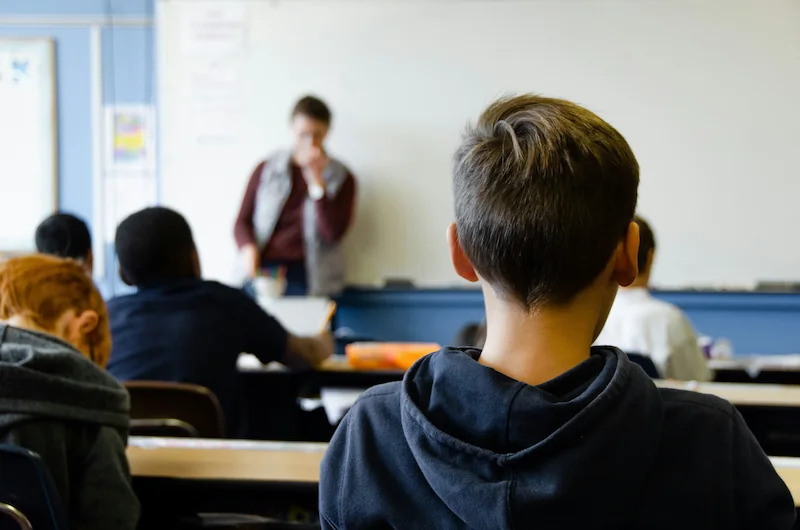
What I saw during my time in Las Vegas unsettled me. Schools are still not neutral spaces that occasionally fail marginalized students, but they frequently continue to operate as extensions of state power, reproducing racial, gendered, and class hierarchies while presenting themselves as engines of equality. The violence I witnessed little children suffer regularly was not spectacular but ordinary: routine humiliations, exclusions, racial and gendered harassment, cruelty, and forms of institutional disregard. These types of everyday slow violence shaped children’s educational experiences. Schools alienated children from their love for education.
Schooling versus Education
Slow Violence is built on the premise that education is distinct from schooling. Education represents the broader human process of developing critical thought, and the capacity to understand and transform the world. Schooling, by contrast, refers to the institutional structures through which the state organizes, and often disciplines, populations. The book echoes Paulo Freire’s distinction between liberatory education and “banking,” and Cliff Stratton’s documentation of US American schools as historically purposed to incorporate marginalized students into existing racial, economic, and political hierarchies.
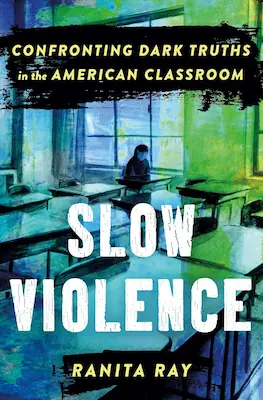
The history of Indigenous boarding schools in the US provides a clear illustration of the violent purpose of schooling. The forced removal of Indigenous children from their families in the name of education reveals that schools have long served political projects extending well beyond learning itself. Drawing on abolitionist educational scholarship, including the work of David Stovall, I argue that literacy and education should not be conflated with the institutional practices of schooling, which have often worked to assimilate, exclude, and discipline children.
These historical arguments are reinforced through my ethnographic observations. I document patterns of teacher racism, misogynoir, hostility toward immigrant students and their families, curriculum mobilized to divorce past histories of oppression from the present, and more. What I found particularly striking was how contemporary antiracist language can itself become mobilized in ways that obscure rather than challenge oppressive systems, allowing educators to invoke race-conscious discourse while reproducing racial inequalities.
The book also revisits one of the foundational narratives of US American educational reform: Brown v. Board of Education. While dismantling legal segregation is an unquestionable watershed moment for public schooling, we must reconsider what was lost alongside integration. The desegregation process displaced thousands of Black educators and administrators, weakening institutions that had served Black communities for generations. Drawing on scholars such as Michael Dumas, Amanda Lewis, and John Diamond, I argue that integration has often been evaluated primarily through proximity to whiteness rather than through educational experiences, institutional power, or student well-being. Black and Brown students continue to encounter tracking, criminalization, and harassment within formally integrated schools.
In the book I question the widespread assumption that teaching is inherently an altruistic profession.
Simultaneously, metrics such as achievement gaps and standardized test scores that remain the principal indicators through which schools are judged are incomplete criteria through which to measure student well-being. In Slow Violence I show how these measures obscure forms of harm that cannot be captured through educational outcomes alone.
The experiences of Black and Brown girls exemplify this limitation. Despite often outperforming boys and white students in conventional academic measures, many of the girls of color I observed continued to endure racialized and gendered harassment, routine humiliation, and institutional neglect. Their academic success became evidence for how schools were functioning effectively, even as their daily experiences revealed persistent harm. By privileging measurable outcomes over students’ lived realities, educational policy risks mistaking “resilience” for justice.
In Slow Violence I invite readers to rethink what counts as evidence when evaluating educational institutions. Rather than asking whether and how students succeed within existing systems, I ask what kinds of psychological, emotional, and political costs accompany that success—and whose suffering remains invisible when achievement alone becomes the measure of educational justice.
Who Are Our Teachers?
One of Slow Violence‘s more provocative interventions concerns the role of teachers themselves. Public discourse often portrays teachers as uniformly altruistic actors working within an imperfect system. I challenge this assumption by insisting that teachers, like members of any profession, occupy diverse political, ideological, and social positions. If critical scholarship has encouraged us to examine policing as a system rather than solely the intentions of individual police officers, I ask why schools and their agents are so often presumed to embody democratic and egalitarian values.
Drawing on my ethnographic fieldwork, I document incidents in which teachers mobilized curriculum to reinforce racial and gender oppression, systematically erased the language and cultures of immigrant students, erased the intellect of children of color, shamed students for their bodies or socioeconomic status, and routinely humiliated disabled children—and withheld care and resources—in everyday classroom interactions. These were far from isolated acts of individual prejudice, but they are indicative of institutional cultures that permit—and at times normalize—the denigration of marginalized students.

In the book I question the widespread assumption that teaching is inherently an altruistic profession. Such romanticized understandings obscure the fact that teachers enter the profession for many different reasons and, like workers in other sectors, deserve to be understood within the realities of labor, employment, and institutional incentives. Treating teaching as a “calling” rather than as work has often undermined union struggles for better pay, stronger labor protections, and improved working conditions.
My interviews with educators in Nevada’s Clark County School District revealed how some teachers entered the district as a pathway to retirement while others viewed teaching as a temporary occupation before another career, and still others were attracted by the prospect of a stable job. None of these motivations are inherently problematic; rather, they underscore the importance of abandoning simplistic assumptions about teachers as a politically homogeneous group who take up teaching as a “calling.”
Moreover, we cannot ignore inequalities within the teaching profession itself. During my research I heard accounts of racial discrimination in hiring that, at least partially, shaped the persistent demographic gap between predominantly Black and Brown student populations and an overwhelmingly white teaching workforce.
It is imperative to distinguish this critique from arguments against teachers’ unions or public education. On the contrary, I think we need stronger unions that advocate for teachers. Far from a call to de-unionize or privatize schools, I argue, as did Diane Ravitch, that undermining unions and privatizing education are modes of exploitation. Teachers are not, by any means, to carry the sole culpability for educational inequality, but meaningful change requires recognizing educators as participants in complex institutional structures rather than treating them as uniformly benevolent actors beyond critical examination.
Rethinking Schools as Democratic Institutions
The book concludes by challenging one of the most enduring assumptions in US American political culture: that schools function primarily as safe havens and engines of democratic opportunity. During debates over school closures and reopening amid the COVID-19 pandemic, public schools were frequently described as protective spaces for vulnerable children. I don’t dismiss the important services schools provide, but this narrative often obscures the experiences of many marginalized families who regard classrooms not only as places of learning but also as sites of surveillance, humiliation, and trauma.
Rather than proposing a simple blueprint for replacing schools, Slow Violence invites readers to ask more fundamental political questions. If schooling is deeply intertwined with broader systems of racial capitalism, labor, and state governance, then reimagining education requires reimagining these institutions as well, as abolitionist thinker Ruth Wilson Gilmore tells us: institutional transformation cannot occur in isolation from wider social change.
Let’s think beyond educational reform. Let’s reconsider the political assumptions that underlie debates about schooling itself. Whether readers ultimately accept this argument or not, I want us to at least confront questions that have too often remained outside mainstream educational debate: What kinds of institutions are schools? Whose interests have they historically served? And what would it mean to imagine education beyond the limits of the schooling system as we know it? By placing schools alongside prisons, policing, and other institutions increasingly subject to structural critique, Slow Violence challenges readers to reconsider one of the most taken-for-granted institutions of modern democratic life.