Before a medieval sculpture became an image to be looked at, it was an object that someone made and learned through touch. We tend to forget this—standing in a museum or cathedral, we usually encounter medieval art as viewers.
We ask what a sculpture represents, who commissioned it, what it meant to its audiences, or how it fit into the religious and social world that produced it. These are the questions that I was trained to ask as an art historian, and they remain necessary ones. But there is another question that we rarely ask with the same seriousness.
What did it feel like to make it?
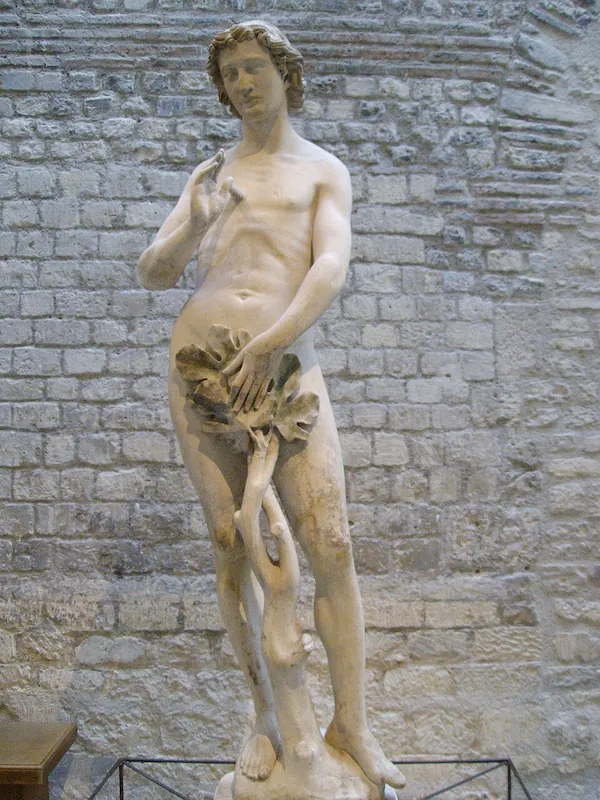
Imagine a sculptor in thirteenth-century Paris standing before a block of limestone. Over months, the rough stone slowly becomes a human body. The sculptor first removes great masses of stone with hammer and chisel. Later come quieter gestures: scraping, filing, rubbing, polishing. As the figure emerges, this labor becomes increasingly intimate.
To steady the stone while smoothing its surface, the sculptor leans against it. One hand holds a file or polishing stone while the other braces the figure’s shoulder, hip, neck, or thigh. The warm flesh of the artist’s body presses repeatedly against the cold flesh of the stone. The sculptor’s own body must adapt to the body they are making. It is impossible to carve a life-sized body without touching it.
As I worked on the project, I found myself moving repeatedly between two scholarly conversations that rarely intersect: queer studies and materiality studies.
This simple observation, which came to me while studying a life-size nude statue of Adam from Notre-Dame Cathedral in Paris, became the starting point for my recent book, Queer Making: On Artists and Desire in Medieval Europe. The fundamental claim of the book is that acts of making put the bodies of artists into particular kinds of situations and positions that we can read through the lens of queer desire.
Medieval painters, sculptors, goldsmiths, textile artists, and others regularly interacted with materials such as stone, wood, bronze, gold, silver, ivory, wax, thread, and cloth. They worked with hammers, chisels, gouges, drills, axes, files, scrapers, burnishers, brushes, and needles. Their interactions with these materials and tools were necessarily intimate, involving touch both gentle and violent, brief and repetitive. The finished object still bears traces of these encounters, even when the maker’s name and life have disappeared from view.
The Missing History of Making
One of the most important developments in historical studies over the past several decades has been the recovery of lives and experiences that earlier histories overlooked. Scholars of medieval studies have shown that medieval ideas about gender, sexuality, and embodiment were far more varied and complex than older narratives allowed.
In art history, queer approaches have often focused on two questions: identity and iconography. Scholars have asked whether particular artists, patrons, or viewers might be understood through queer histories. Others have explored images whose subjects, forms, or meanings invite queer interpretation.
These approaches have transformed the field. They have revealed gender instabilities and erotic possibilities at the heart of medieval culture. They have also made it harder to sustain the old assumption that the Middle Ages were simply distant, pious, and sexually uniform. But they have left another part of artistic life largely untouched. What about the making itself? We have become extraordinarily adept at interpreting finished objects, but pay less attention to the bodily experiences that brought them into existence.
Making art is never simply an intellectual act. It is an embodied activity, learned through muscles as much as through the mind. Different materials ask different things of the body. Stone is struck and polished. Wood is gouged, scooped, honed, planed, and scraped. Ivory is warmed by the hand and slowly caressed into form. Wax yields and bronze flows.
These physical encounters are not incidental to artistic production. They are the conditions under which art comes into being. And they were not only experienced by artists—they were seen and witnessed by the people who lived alongside them. People throughout medieval towns, cities, and monasteries saw works of art being made, and sculptors’ hands touching the bodies they created.
The psychology of making works of art was complex, then as now. People don’t make a work of art for just one reason, or feel just one particular way while they are making it. Devotion, skill, economic necessity, ambition, boredom, frustration, beauty, play, and desire could all intersect in the labor of creation. Binaries like sacred and secular, devotion and monotony, creativity and repetition do not hold for long when we imagine the experience of making an object over days, weeks, months, or years.
Why Queer?
The title Queer Making does not begin from the assumption that we can identify which medieval artists were “really” queer. In most cases, we cannot. This is not simply a problem to be solved—it is a fundamental truth about the kinds of sources that exist from the distant past.
We know remarkably little about the personal lives of most medieval makers. Few left first-person accounts or letters. Few described their working days, their bodies, their pleasures, or their fears.
Often we cannot connect a name to an object at all, and even when we can, the name rarely tells us what we most want to know. But the absence of evidence about identity should not stop us from asking questions about experience.
In the past several decades, queer studies has expanded beyond arguments over terminology and identity categories and towards questions of embodiment, affect, lived experience, and phenomenology.
We have moved beyond asking only, “Did queer people exist in the past?” We can ask instead how people with queer bodies or desires experienced and shaped their world. For the study of medieval art, the implications of this shift are profound.
What did it feel like to be an artist, craftsperson, artisan, or maker shaping objects in medieval Europe? What kinds of bodily positions did techniques require? What forms of touch did materials demand? How might the repeated handling of stone, ivory, wax, wood, silver, cloth, or skin have opened moments in which desire became relevant, meaningful, or impossible to ignore?
These questions do not require certainty about the inner lives of anonymous makers. They require something more difficult: a historically grounded act of imagination and speculation. That shift—from asking who medieval artists were to asking how artistic labor was experienced—changes the kinds of historical questions we are able to ask, and the methods necessary to answer them.
Speculative Histories
In Queer Making, I use both historical and material sources, as well as speculative and imaginative reenactment, to fill in some of the wide gaps in our knowledge about what it felt like to make things in the Middle Ages. This kind of speculation has limits. We cannot reconstruct a medieval artist’s inner life with confidence when no testimony survives, and we should not pretend otherwise. But all historical interpretation involves some act of reconstruction, especially when we write about people whose lives were only partially recorded.
As I worked on the project, I found myself moving repeatedly between two scholarly conversations that rarely intersect: queer studies and materiality studies. Queer studies offers ways to think about desire, orientation, embodiment, and the instability of identity. Materiality studies asks us to take matter and materials seriously: the stone, wood, ivory, wax, thread, silver, and pigment through which medieval art came into being.
Each chapter of the book explores a different material or technique and the specific forms of touch that it invited.
Each field offers only a partial view. But taken together, they allow us to think differently about anonymous medieval makers.
This is why the book turns not primarily to marginal objects or hidden iconographies, but to familiar works of medieval art.
Rather than looking only for images that appear queer in subject matter, it asks whether even mainstream objects—devotional sculpture, ivory carvings, reliquaries, paintings, textiles—might preserve traces of queer experience in the processes by which they were made.
Some of these objects may not look erotic at all. But the steps of their fabrication placed makers into physical situations in which their own sexual subjectivities could have become relevant. A sculptor carving a life-sized nude, an ivory carver polishing beautiful bodies, a textile maker fitting clothes to the body of a client: each encountered materials in ways that were technical, bodily, and potentially charged. These kinds of acts are rich with erotic possibility, even if that possibility surfaced differently in the hands of different people.
To read medieval art through making is therefore to recover another history: not only a history of images, but a history of bodies at work. And once we begin looking for that history, familiar objects begin to change. They no longer appear only as finished monuments but as sites for intimate, embodied encounters between people and materials.
Recovering these encounters will never allow us to know precisely what medieval artists desired. But it reminds us that the anonymous makers who filled Europe’s churches and museums were not simply hands executing commissions. They were fully embodied people whose artistic labor unfolded through touch, repetition, imagination, and sometimes desire. That recognition changes not only how we think about queer history, but how we think about the making of art itself.
Holding Hands in Wood
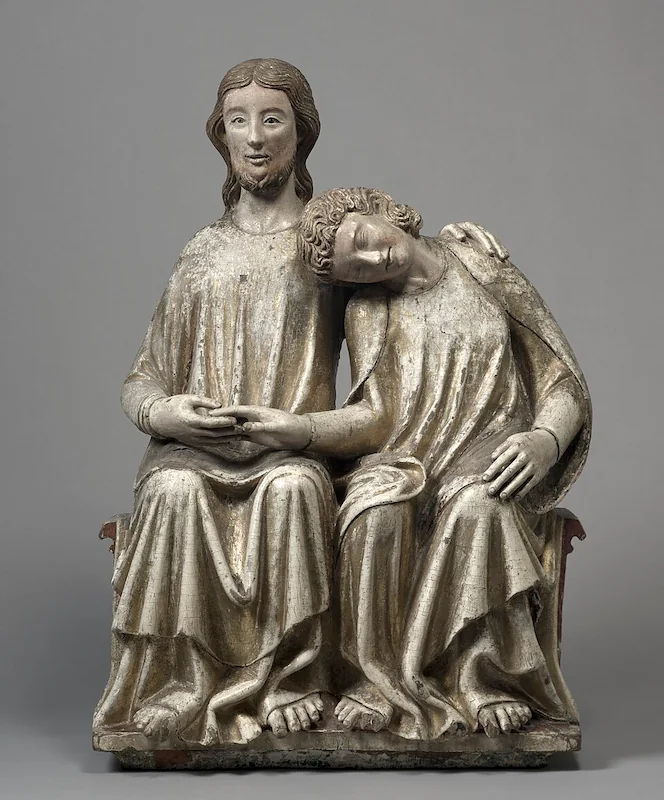
As an example, let’s take a wood sculpture created in southern Germany in the early 14th century, now in the Cleveland Museum of Art. The subject is intimate: Christ and Saint John seated next to one another, with John asleep on his shoulder. At the center of the piece, the two men hold hands.
The sculpture is already canonical in queer medieval art history (it was included in the Metropolitan Museum’s fantastic recent show, Spectrum of Desire: Love, Sex, and Gender in the Middle Ages) because of the emotional intimacy of the two figures, who are carved from one block of wood. Some scholars have also read the gesture of the hands at the center as one of marriage—spiritual rather than earthly.
Read More
Rather than reading the queer iconography of the image, my book focuses on process. In carving the delicate details of the two hands touching at the center of the piece, probably with a small knife, scraper, or gouging tool, the artist’s hand would necessarily have joined Christ and John’s, turning a marriage gesture of two hands into a more ambiguous joining of three hands. In sanding and filing details of the draperies, the artist would have clasped their own body against John’s in the same way that John’s body is joined with Christ’s. The artwork simply cannot be made without these forms of touch.
Similarly, in carving a wood statue of the Virgin Mary (such as this example in the Victoria & Albert Museum in London), an artist would have to touch Mary’s body in a way that no viewer would dare to, from carving out her cinched waist to smoothing the surfaces of her breasts. People would have seen the artist do it; how might they have responded? With laughter and jokes? Reverence and awe? Indifference? Making artworks led to moments of touch in public that were usually kept in private.
Materials and Desire
Each chapter of the book explores a different material or technique and the specific forms of touch that it invited. After chapters on monumental sculpture in wood and stone, the third chapter explores ivory—the way that it invites caressing touch and warms to the hand. A chapter on wax and metal casting explores the process of creating models in wax through warming, shaping, pressing, and molding this uncanny material.
A later chapter on clothing and textiles imagines the fittings that took place between tailors and their clients. By the fourteenth century, tailoring increasingly depended on repeated fittings between tailor and client. These moments of intimacy could have led to forms of touch that were violating or quietly erotic. The book’s conclusion asks what forms of touch were involved in the daily cleaning and maintenance of works of art by monks, nuns, and laypeople.
The point of these examples is not that every medieval artist experienced desire while making art; they certainly did not. The point is that making itself created situations in which desire could emerge, just as boredom, devotion, ambition, frustration, or joy could emerge. Recovering those possibilities reminds us that medieval artists were not abstractions or anonymous hands. They were embodied people whose encounters with materials were as psychologically rich and unpredictable as our own.