
Honesty is eroding in many areas of society today. Indeed, it is not mere rhetorical flourish to say that we are facing a number of honesty crises. Here are a few examples:
- In education, a survey of UK undergraduate students found that more than half of them were using AI to complete at-home graded assignments.
- In relationships, 1 out of every 7 young adults in the US in a serious relationship said they were simultaneously involved with an AI romantic companion.
- In religion, a survey of Protestant church leaders found that 64% admitted to using AI to help with writing their sermons.
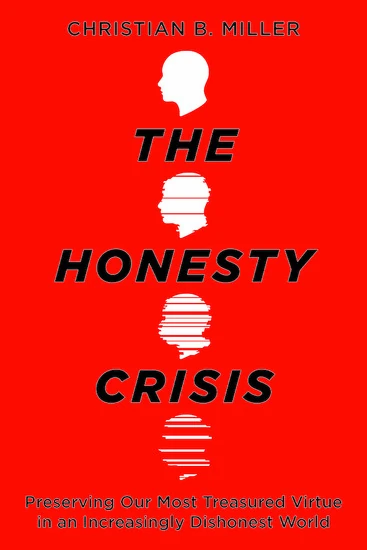
In my new book, The Honesty Crisis: Preserving Our Most Treasured Virtue in an Increasingly Dishonest World, I call attention to areas of society like these where honesty is especially under threat and where we need to do what we can to reverse course.
What is an honesty crisis? As I understand it, an honesty crisis arises wherever two things happen in an area of society. First, certain dishonest actions have become significantly more appealing or tempting than they were before. Cheating on graded assignments using AI, or having an AI take care of a weekly sermon, are two illustrations.
The second feature is that dishonest behaviors have also at the same time become easier to get away with and harder for others to detect. AI use, for example, is a lot more difficult to track down than is whether someone borrowed material from the Internet. Same with having an affair with an AI romantic companion as opposed to a real person.
In the book I examine in extensive detail six honesty crises which I see arising in the US, although they extend more broadly as well. They have to do with AI student cheating, deepfakes, celebrity and dishonesty, political misinformation, AI sermon plagiarism, and Internet infidelity.
A thread running through all of these crises is the availability of new technology. To be sure, I never argue that technology is inherently bad or dishonest. Instead, on my way of thinking it is inherently value neutral. But with developments in the past thirty years, we now have available to us new tools which can be used to both make dishonesty easier to get away with and more tempting to try.
Below, we will look at the case of the honesty crisis surrounding fake news. But first, we should say something about what honesty is, as well as why it matters.
Clarifying What Honesty Is
What is this thing called honesty? Initially, it might seem as simple as just telling the truth. But there is more to it: honesty prevents lying, but it also prevents a host of other negative behaviors, such as misleading, cheating, stealing, hypocrisy, BS-ing, and self-deception. It is remarkably broad in scope. At its core, though, honest behavior involves not intentionally distorting or misrepresenting reality as the person takes it to be. Honest people authentically present matters as they truly see them.
It is imperative that we continue to develop, test, and implement strategies for promoting honest behavior.
Honesty is also a virtue, which means it is an excellence of character. It is both valuable in its own right and contributes to a person’s flourishing.
Underlying psychology matters too. For instance, what motivates honest actions makes a considerable difference in whether we are behaving virtuously or not. If a student does not cheat on a test, even when he has the opportunity to do so, that is the honest thing to do. And if his reason for not cheating is that he believes cheating is wrong, or that he does not want to disrespect his professor, those are excellent reasons.
If, instead, he refrains only out of fear of punishment or a desire to avoid feeling guilty, then we do not have a case of virtuous motivation. This even includes hoping to get rewarded in the afterlife or avoiding divine punishment. These four motives are all self-centered or egoistic, making honesty all about how it benefits the person in question. Virtue demands that we act well regardless of whether we think we will benefit or not.
Why We Should Care
Even if honesty is under pressure today, it is worth asking why that matters. Who cares if, in the areas of society where honesty is eroding, people are cheating on their significant others, sharing political misinformation at a higher rate, or plagiarizing on their academic work (or sermons!) to a greater extent than they were in the past?
Very likely, though, most people already care a great deal about whether honesty is eroding in society. Indeed, in one of the studies our team at the Honesty Project at Wake Forest University ran, honesty ranked first among sixty traits when participants judged which characteristics made a person likable, respectable, and worth knowing. It turns out honesty is highly valued.
Strategies involving fact-checking, source labels, and accuracy prompts have all shown some promise.
For good reason, I might add. Think about what life would look like if dishonesty prevailed. Trust would be in peril. Everyone would be instrumentalizing one another for their own self-interested gain. We would also likely live in perpetual anxiety, worrying about whether another person is always on the brink of cheating or stealing from us.
Contrast this with an honest society, where people trust one another and depend on others to do as they say they will do. People are treated with respect, and their contributions are valued and dignified. Calm and peace would be expected in place of fear and anxiety.
The Honesty Crisis Surrounding Fake News
There are likely several different honesty crises going on at the moment in American politics. But one of them that seems to be quite widespread, and not just limited to the actions of politicians, has to do with fake news. Without getting bogged down in definitional details, let’s say that ‘fake news’ is any news story that is fabricated and yet is being presented as if it were coming from a reputable or reliable news source.
Fake news travels rapidly on social media, and much more so than accurate news stories typically travel.
When it comes to believing a piece of fake news, current research in psychology suggests that partisan desires play a role in whether someone believes it or not. If the news content happens to align with our political views, then we are more likely to believe it. If not, then we are less likely to believe it.
But it turns out, at least so far as we can tell at the moment, that political alignment appears to not make a huge difference to what we believe. Instead, perceived accuracy tends to be much more impactful. As two of the leading researchers on fake news, Gordon Pennycook at the University of Regina and David Rand at MIT, note, “the effect of political concordance is typically much smaller than that of the actual veracity of the news. In other words, true but politically discordant news is typically believed much more than false but politically concordant news – politics does not trump truth.”
To illustrate, consider an imaginary headline like this one for a fake news story:

“Pope Francis publicly endorses Kamala Harris for President in the 2024 U.S. election.”
While this headline might have been welcome news to some Democrats, they are also not likely going to believe that it is accurate. Since perceived accuracy is more important for many of us than political alignment – and this applies to Democrats and Republicans alike – few are going to form the belief that Francis endorsed Harris. This, anyway, is what a body of research on political psychology and fake news tells us.
Some good news for honesty, I want to say. We at least tend to care more about the accuracy of our informational sources than about whether the information aligns with our political views, and that is what you would expect of an honest person.
But now, consider this research finding from Pennycook and his collaborators. Participants in a study published in 2021 were given the following headline:
“Over 500 ‘Migrant Caravaners’ Arrested With Suicide Vests”
Pennycook reports finding that:
“This was rated as accurate by 15.7% of Republicans in our study, but 51.1% of Republicans said they would consider sharing it.”
This is a stunning disconnect.
Presumably few Republicans in the study were going to believe that there were 500 people arrested with suicide vests. Even though the story might fit into an anti-immigration narrative many Republicans endorse, the seeming implausibility of such a story (hence the low accuracy) makes it really hard to believe. And yet the majority of these participants said they would consider sharing it. Admittedly, that is not the same as deciding they would share it, which is also not the same as actually sharing it on their social media accounts. Still, if you don’t think it is accurate, then why would you even consider sharing this story?
Now we have the makings of an honesty crisis.
What is going on here? Ordinarily we might think that if you share a news story on social media, it is because you believe the story is accurate and you want others to become aware of this information as well. So the causal pathway goes from coming into contact with a news story, to believing it is accurate, to thinking it would be good for others to become aware of this information too, to wanting to share it, and finally to actually sharing it.
But in light of findings like the one above, this model is obviously too simplistic. Instead, sometimes the sharing of news on social media appears to bypass belief altogether.
Alas when this happens, the consequences can be significant. Fake news travels rapidly on social media, and much more so than accurate news stories typically travel. Soroush Vosoughi at MIT and colleagues looked at data from 3 million people on Twitter from 2006 to 2017 and found that “falsehoods were 70% more likely to be retweeted than the truth.”
In a stunning result, they report that “Whereas the truth rarely diffused to more than 1,000 people, the top 1% of false-news cascades routinely diffused to between 1,000 and 100,000 people.” And of the false news, it was the political news that spread the most – to the most people, and at a faster speed. It reached “more than 20,000 people nearly three times faster than all other types of false news reached 10,000 people.” So the point is that even small groups of people initially sharing fake news could still lead to it spreading far and wide.
There is much more to be said in unpacking the psychology behind our apparent willingness to share fake news. But hopefully this is enough to get a better sense of one area where I am worried about the future of honesty.
Moving Forward
All, though, is not lost. For each of the honesty crises I examine, I also discuss ways in which we might try to combat them. In some cases, I am pessimistic about our chances of doing so successfully, such as student use of AI on graded assignments. In other cases, I am more optimistic.
The sharing of fake news falls into this second category. Researchers have now developed a variety of strategies aimed at nudging people into an accuracy mindset and away from a social media mindset which is concerned primarily with status and followers. For instance, strategies involving fact-checking, source labels, and accuracy prompts have all shown some promise.
It is imperative that we continue to develop, test, and implement strategies for promoting honest behavior. Otherwise, we are in danger of losing what is arguably our most treasured virtue.
(Acknowledgment: The first and second sections are adapted from “Confronting the Honesty Crisis,” with permission from Merion West. The third section is adapted from The Honesty Crisis, with permission from Oxford University Press.)