Voting against economic interests is one of the oldest accusations in democratic politics. A factory worker backs a party that weakens unions. A farmer supports a candidate whose trade policy hurts exports. The charge assumes that voters have an economic interest, that the interest is obvious, and that a rational person would follow it. Each assumption can be tested.
- A Charge With a Long Pedigree
- Interests Come in More Than One Currency
- What the Data Show About Status Loss
- Perceived Insecurity and Mixed Motives
- Values Count as Interests Too
- The American Case: Status Threat
- Why Measurement Decides the Answer
- What a Fair Test Would Look Like
- Where the Evidence Leaves the Question
Recent research does test them, and the results complicate the accusation. Voters who appear to act against their own interests often respond to a loss of standing, to a perceived threat to their way of life, or to moral commitments they rank above income. Whether those motives count as interests determines whether the word irrational applies.
A Charge With a Long Pedigree
Thomas Frank gave the accusation its best-known form in What’s the Matter with Kansas?, where he asked why social conservatives keep voting for a party whose economic agenda works against them. The question has framed the debate ever since, and most later work either answers it or rejects its premise.
Two later books approached the same voters differently. Katherine Cramer’s The Politics of Resentment follows rural Wisconsin residents and documents a deep resentment toward cities, along with the way that resentment shapes how they judge politics. She argues that this rural consciousness rests on a belief that rural communities receive too little power, resources, and respect.
Arlie Russell Hochschild’s Strangers in Their Own Land describes conservative voters who feel that others have cut ahead of them in the line to the American dream. Both books show voters who treat politics as a question of respect and fairness as much as of money, and an analysis that ignores those terms misses what the voters themselves say they want. Taking that sense of loss seriously leads to a prior question: what counts as an economic interest?
Interests Come in More Than One Currency
The accusation usually measures interest in absolute terms: income, taxes, benefits. Economists and sociologists have long argued that people also care about position, meaning how their resources compare with those of others. A recent article by Giuseppe Ciccolini in Perspectives on Politics builds on this idea and notes that people often want money as much for the status it brings as for what it can buy.
Status has a feature that income lacks. The scale of economic status is fixed, because one group’s rise in rank is another group’s fall. A society can grow richer while some groups lose position. Members of those groups have suffered a real economic loss, even when a standard income table shows no decline.

This point matters for the accusation. A critic who checks only whether a voter’s income rose under a policy has measured one dimension of interest and ignored another. A voter who sees neighbors, coworkers, or a rival group pulling ahead may reasonably conclude that the policy hurt, and no income table can refute that conclusion on its own terms.
What the Data Show About Status Loss
Ciccolini tested the idea with European Social Survey data from 23 elections in 11 Western European countries between 2008 and 2019, combined with Eurostat income data. His measure of positional income places each social class between the richest and the poorest tenth of society and tracks changes over five years. Classes that moved closer to the poor than to the rich were more likely to vote for populist radical right parties.
Sweden illustrates the mechanism. In the data Ciccolini presents, every Swedish class saw its income rise until at least 2014. Low-skilled service workers gained 18 percent, while the richest households gained 35 percent. Their income grew, and their position fell.
The effect is modest but visible. Populist radical right parties won 14 percent of the vote among classes with the most typical drop in positional income and 11 percent among classes with the most typical gain, against an average of 12 percent. The center right and the left both lost ground among classes losing status, so no single rival explains the pattern. The association concentrated among voters with low or medium education.
The modest size deserves emphasis. Status loss is one factor among many, and the study cannot say how any individual voter decided. It does show that a pattern which looks like voting against economic interests on an income measure looks different on a positional one.
Perceived Insecurity and Mixed Motives
Material hardship does not always drive the vote. Sipma, Lubbers, and Spierings used European Social Survey data from 12 Western European countries between 2002 and 2014 and compared workers in permanent jobs with workers of the same class who lacked permanent employment. Perceived job insecurity was associated with voting for the radical right. Actual insecurity, measured by temporary employment, was not. Workers in that position leaned toward the radical left instead.
A society can grow richer while some groups lose position.
Another study complicates the picture of who votes for these parties. Cordero, Zagórski, and Rama analyzed more than 60 regions in 10 European Union countries. Upper-class natives supported populist radical right parties where migrant unemployment was high, whatever the migrants’ origin, a pattern consistent with worry about fiscal burdens. Lower and middle-class natives responded only where unemployment was high among migrants from outside the Union.
These findings replace the image of a poor voter misled about money. Wealthier voters respond to fiscal calculations. Poorer voters respond to a mix of perceived insecurity, status, and identity. Frustration with the gap between democratic ideals and democratic practice adds a further motive. The label of voting against economic interests fits some of these cases and misses others.
Values Count as Interests Too
Economists have also begun to take moral commitments seriously. Enke’s review in the Annual Review of Economics describes a divide between universalism, which extends moral concern to all people, and particularism, which concentrates it on one’s own group. The divide helps explain the realignment of rich liberals and poor conservatives. The review reports that universalism explains left-wing policy views and voting considerably better than traditional economic variables.
Seen this way, moral priorities form part of what voters want from politics. A wealthy voter who backs higher taxes and a poor voter who defends the traditions of a community both give weight to something besides income. If voting against economic interests is irrational, a large share of voters on every side qualifies.
The symmetry is easy to overlook. The accusation is almost always aimed at working-class conservatives, yet affluent progressives who support policies that raise their own tax bills would fail the same test. A standard that condemns only one group’s departures from narrow self-interest is a political judgment dressed as a measurement.
The American Case: Status Threat
The American literature moves further toward culture. Diana Mutz, using panel surveys that followed the same respondents over several years, concluded that anxiety among high-status groups, not economic hardship, explained support for Donald Trump in 2016. Her cross-sectional analysis found no evidence that economic dissatisfaction played a role in vote choice.
A sociologist, Steve Morgan, reanalyzed her data. His point is that a measure of status anxiety may partly capture economic worry, so he argued that material interests and status threat are too entangled to rank, and that her panel results are consistent with economic interests mattering at least as much.
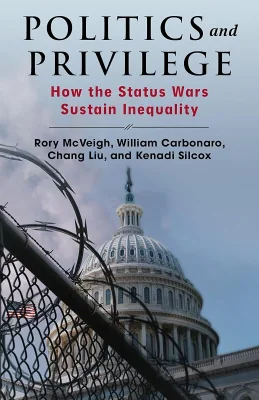
Parker and Lavine offer the most systematic test. They built a seven-item scale of status threat, fielded it in two panel surveys of white Americans, and found it was the strongest predictor in five of nine outcomes, including beliefs about demographic change, discrimination against whites, and conspiracy thinking. Family income did not predict status threat. Research on social identity and intergroup threat describes the same mechanism from the psychological side.
Their placebo test sharpens the contrast with Europe. On a composite of five economic policy questions, including taxing the wealthy and raising the minimum wage, the effect of status threat was precisely zero. The authors conclude that redistribution alone will not ease the anxiety, because it concerns symbolic standing. They also report that among respondents with little political knowledge, those most threatened were about 20 percentage points more liberal on economics.
Why Measurement Decides the Answer
The Mutz and Morgan exchange shows how much any claim about voting against economic interests depends on method. Both authors worked with the same data and reached different conclusions about whether material interests or status anxiety carried more weight. The reason is that the two forces overlap in real life. A person worried about their group’s standing often also worries about jobs, wages, and neighborhood decline, and survey questions rarely separate the strands cleanly.
Three limits apply to this whole literature. Most of the evidence is observational, so it shows associations and not causes. Survey measures of threat and insecurity rely on self-report, which can reflect political loyalty as much as experience. And the studies cover different countries and periods, so findings from Western Europe cannot be transferred to the United States, or the reverse, without care.
These limits do not weaken the central point. They strengthen it, because anyone who claims confidently that a group of voters acts against its economic interests must have solved measurement problems that the researchers who study them treat as open questions. A confident verdict on any group of voters claims more than the evidence provides.
What a Fair Test Would Look Like
A fair test of voting against economic interests would need three things. It would define the interest in advance, including position and security as well as income. It would compare what voters expected from a policy with what they received. And it would apply the same standard to voters on the left and the right.
Most public arguments invoke a single measure, usually income or the tax bill, and apply it selectively. The evidence supports a more modest claim: in some places, for some groups, the policies a party delivers do not match the material goals its voters report. That claim is narrower than the charge of irrationality, and it leaves room for the possibility that the voters know something about their own situation that the critic does not.
The charge also carries a cost for democratic debate. When opponents are told that they cannot understand their own interests, they have little reason to engage, and the accusation hardens the divide it was meant to explain. Cramer and Hochschild both make this point from the field, in different ways: the people they describe resent being dismissed as mistaken.
Where the Evidence Leaves the Question
Ciccolini and Parker and Lavine agree that status matters more than absolute income. They disagree about what kind of status. In the European study, status is economic: a class’s position between the rich and the poor, and its loss predicts the vote. In the American studies, status is cultural, and economic measures add little. Differences in country, data, and measurement make the two results hard to compare directly.
Three conclusions survive the disagreement. Relative position is an economic interest in its own right, so voters who respond to status loss are not ignoring economics. Perceived insecurity and group identity shape political choices, sometimes more than hardship measured objectively. Moral commitments belong among the things voters want from politics.
Irrationality is the wrong diagnosis for most voters in these studies, and voting against economic interests is a poor description of what they do. They respond to losses of standing, to fears about security, and to commitments they hold dear. Whether those responses serve them well is a legitimate question. Answering it requires first admitting that they respond to something real.
The practical lesson follows from this. Parties and commentators who treat voting against economic interests as a puzzle of ignorance will keep proposing the same remedy, which is more information about policy. If the motive is status, belonging, or morality, the remedy has to address those directly. Telling voters what their interests are has rarely persuaded anyone, and the research suggests why: the voters were weighing interests the critic never counted.
Selected Readings